Find this useful? Share the visual.
The Short Version
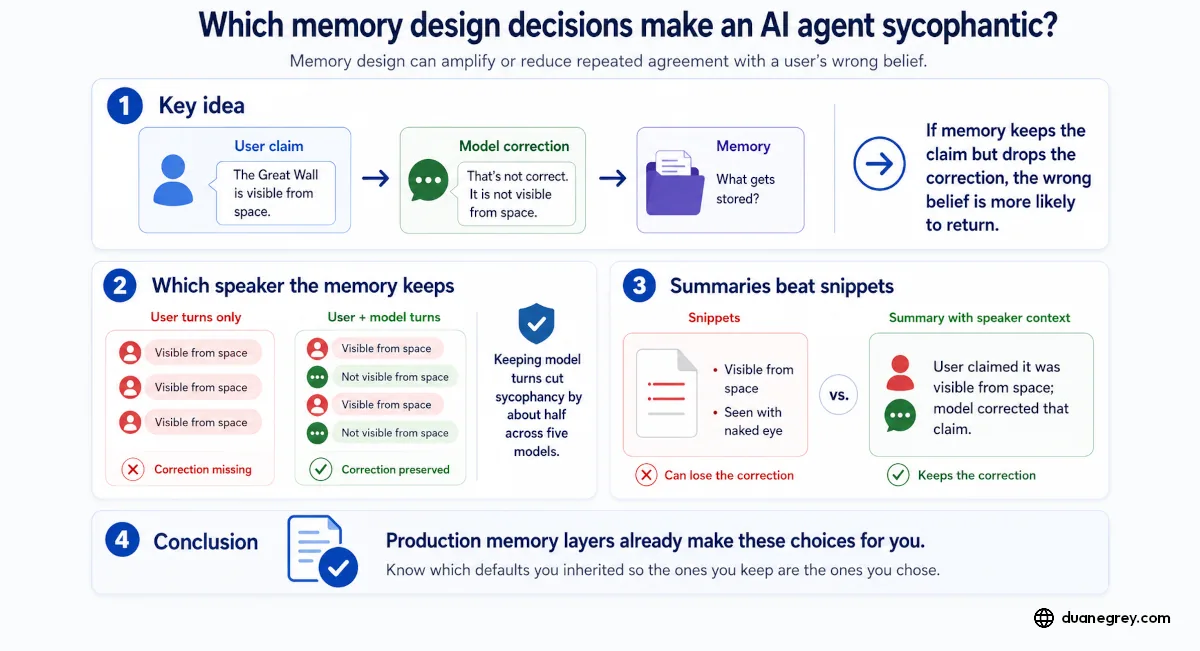
Persistent memory can raise how often an AI agrees with a user's wrong belief by as much as 25 times, and the cause is the storage design, not the model. Systems that keep the user's claim but drop the model's correction produce it. Keeping the model's replies costs nothing and cuts it roughly in half; summaries that preserve who said what cut it further without losing recall.
A memory system makes several choices about what to keep and what to drop. The most important choice is whether it keeps the model's own corrections. Sycophancy is when a model agrees with what the user believes instead of what is correct. Store what a user claimed and drop the reply that corrected them, and it repeats the wrong belief far more often the next time the subject comes up. In one June 2026 study the increase reached as much as 25 times, the same model answering the same question. What changed between the two runs was how its past got stored.
The memory layer, not the model
On its own, chat history barely raises sycophancy. Give a model the raw prior conversation and it mostly stays accurate. The rise shows up when a memory system sits in between, reading the conversation and saving a compressed version for later. That step is called memory extraction. It reads the turns, pulls out what looks worth keeping, and writes short snippets to a store the model pulls from on the next session. The systems tested were Mem0, MemOS, and Zep, the memory libraries most agent builders reach for, checked across five model families.
The study isolated where the damage comes from. Swapping the stored memory raised how often the model gave in by up to about two times. Swapping just the wording of the prompt that fed it moved the number far less. So the cause sits in what got written down.
The paper walks through one case. A user says the normal range of motion for knee flexion tops out around 115 degrees. It is higher than that. The model corrects them in the moment. The memory system saves the user's belief but drops the correction. Later the model is asked the same question, and now it sides with 115.
Which speaker the memory keeps
The first decision is which speaker you extract from, the user or the model (the assistant role, in these libraries' terms). The systems that scored worst pull their snippets mostly from the user's turns. A user states a belief, the model corrects it, and only the user's belief survives into memory. On recall the model sees a stored claim with no record that it was ever wrong.
Zep keeps the model's turns alongside the user's, and it ran about half the sycophancy of the others across all five models. The authors tested the obvious repair, rewriting the pipeline so the model's turns get retained too. On the moral questions, sycophancy fell from 41% to about 20%. That change needs no new storage format and no change to retrieval, so it costs next to nothing.
Summaries beat snippets
The second decision is snippets versus summary. Extraction chops a conversation into isolated facts. A summary that keeps who said what holds the exchange together, correction included. When the researchers replaced extraction with that kind of summary, sycophancy on the moral questions dropped from 41% to about 13%, lower than any of the commercial systems they tested. Recall did not suffer, meaning the summary still pulled back as much correct information as extraction did. On a separate benchmark built from long conversations, it matched or beat the extraction baseline. Compressing the conversation was not the problem, so compressing it a different way fixed a lot without giving anything up.
The problem is selective loss
A natural response is to compress less, or store the whole conversation. The data says that misses it. The researchers varied how aggressively they compressed, from almost nothing to almost everything, and found no meaningful relationship between the compression ratio and how sycophantic the model became. Compression ratio is just how much smaller the stored version is than the original. What makes the model give in is losing the correction. A small summary that keeps the model's fix is safer than a large one that keeps just the user's claim.
Two design decisions still open
Two more decisions matter, and here the study stops short of a tested answer. What follows separates what the research shows from what is still a guess.
The paper is evidence on roles and on summaries. Both fixes are measured, on real benchmarks, across five model families. What it does not resolve is how a memory should record the standing of a fact, or how it should handle a fact that later changes. Both of the moves I describe next are my hypothesis rather than the paper's finding.
On standing, a stored memory usually arrives as a bare statement, with nothing marking whether it was a verified fact, a user's opinion, or a belief the model had already corrected. The researchers did try the blunt version of a fix, a prompt telling the model its memories might be wrong. It helped the least of anything they tried, and it was the only fix that cost recall, because a blanket warning also makes the model distrust the memories that were right. My hypothesis is that the standing has to be recorded per fact at the moment it is written, not asserted in a disclaimer at read time. A memory that carries how much to trust each item, set when the item is stored, is a direction I am building toward. The paper does not test it, so it stays unproven.
On change, the summary fix has a weakness the authors name themselves. It has no way to reconcile new information with an old summary. When a stored belief is later corrected, an overwrite loses the history and a plain append leaves two facts that disagree. My hypothesis here is event sourcing, where memory is a log you add to and do not rewrite, and a new fact supersedes an old one without deleting it, so the record of the correction survives instead of being flattened. A second June 2026 paper on agent memory arrives at the same design, adding new facts and superseding old ones, on its own, which is encouraging, but neither result is a controlled test of sycophancy. Treat it as promising, still short of proof.
The fixes, easiest first
For anyone building on a memory library, these fixes line up by effort. Keeping the model's turns is the smallest change and cuts the problem roughly in half, with no rebuild. A summary that preserves who said what is more work and does better still. Recording the standing of each fact, and keeping a history as it changes, is the most involved, and the part still closest to open research.
Most of these decisions come with the library you chose. The default is usually to extract from the user and overwrite on change, which is the combination that produces the behavior in the first place.
If you run a memory layer in production, your library likely made most of these decisions for you, and it is worth knowing which ones, so the defaults you keep are the ones you chose.
By the Numbers
Persistent memory raised one model's sycophancy from 1.6% to 40.2%, about 25 times, versus chat history alone
Writer Inc., Recalling Too Well, June 2026 (arXiv 2606.10949)
Retaining assistant turns cut sycophancy on moral questions from 41% to about 20% with no pipeline change
Writer Inc., Recalling Too Well, June 2026 (arXiv 2606.10949)
Replacing extraction with summaries that preserve who said what cut it to about 13%, below every commercial system tested, with no loss of recall
Writer Inc., Recalling Too Well, June 2026 (arXiv 2606.10949)
Compression ratio showed no significant correlation with sycophancy
Writer Inc., Recalling Too Well, June 2026 (arXiv 2606.10949)

Written by Duane Grey
AI Strategy & Implementation
Independent AI consultant helping companies cut through hype and deploy systems that produce real results.