What is the difference between using AI as a tool vs. as infrastructure?
Find this useful? Share the visual.
The Short Version
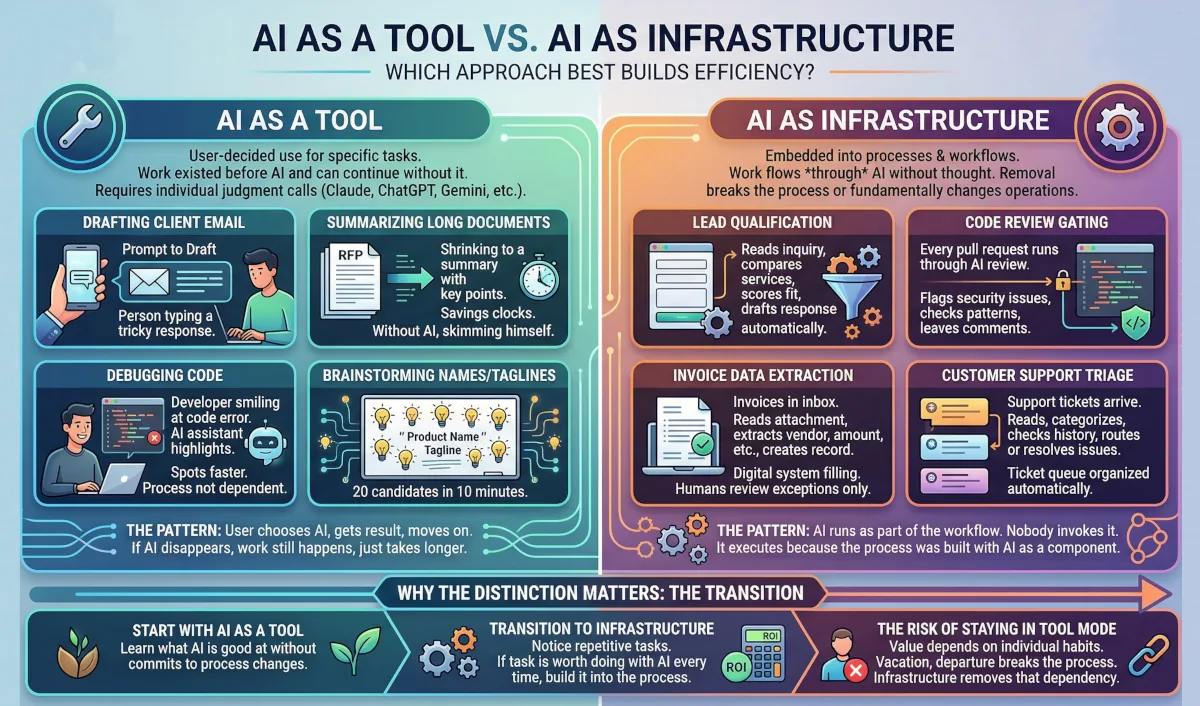
AI as a tool means someone decides to use it for a specific task. AI as infrastructure means the work flows through AI whether or not anyone thinks about it. If the AI disappeared from a tool use case, the work still happens, just slower. If it disappeared from an infrastructure use case, the process breaks. Most teams start in tool mode. The transition happens when you notice yourself doing the same task repeatedly and decide the AI step belongs inside the process, not on top of it.
The difference is whether AI solves a problem when you remember to use it, or whether it is built into how work gets done regardless of who is doing it.
AI as a Tool
When AI is a tool, someone decides to use it for a specific task. The work existed before AI, and it continues whether or not AI is involved. Each task is a judgment call. Is it worth pulling up Claude, ChatGPT, or Gemini for this one?
Drafting a client email. You have a tricky response to write. You open a chat interface, paste the context, ask for a draft, then edit it into your voice. Tomorrow you might write the next email from scratch because you're in a flow state and don't need help.
Summarizing a long document. A 40 page RFP arrives in your inbox. You drop it into an AI tool and ask for the key requirements and deadlines. Without the tool, you would have skimmed it yourself. The AI saved 20 minutes, but the process doesn't change if you skip it next time.
Debugging code. Something breaks in production. You paste the error and surrounding code into an AI assistant and ask what's wrong. It spots the issue faster than reading stack traces. But your debugging process doesn't depend on it being there.
Brainstorming names or taglines. You need five options for a product name by end of day. You prompt an AI model, get 20 candidates, and shortlist from there. Creative work that used to take a whiteboard session now takes 10 minutes. But few people would say your naming process is "automated."
In each case, a person chooses to involve AI, gets a result, and moves on. If the AI disappeared, the work would still happen. It would just take longer.
AI as Infrastructure
When AI is infrastructure, it is embedded into a process or workflow. The work flows through AI whether or not anyone thinks about it. Removing it means the process breaks or reverts to a fundamentally different way of operating.
Lead qualification. A form submission comes in from your website. The system reads the inquiry, compares it against your services, scores the fit, and drafts an initial response. This happens within seconds, for each submission, without anyone deciding to "use AI" on that lead. The AI is the process.
Code review gating. Each pull request in the repository runs through an AI review before a human sees it. The AI flags security concerns, checks for patterns the team has defined as problems, and leaves comments. Developers don't choose to use it. It runs because it is part of the pipeline.
Invoice data extraction. Invoices arrive by email. A workflow reads the attachment, extracts vendor, amount, line items, and due date, then creates a record in your accounting system and flags anything that doesn't match the purchase order. The person who used to do this manually now reviews exceptions instead of processing each document.
Customer support triage. Tickets come in through multiple channels. Before a human agent sees them, AI reads the message, categorizes the issue, checks the customer's account history, and either routes it to the right team with context attached or resolves it directly for known patterns. The queue an agent opens in the morning has already been organized and enriched.
Across each example, AI runs as part of the workflow itself. The process executes because it was built with AI as a component, either through manual procedures that include AI steps or through automated workflows that run without intervention.
Why the Distinction Matters
Most teams start with AI as a tool. That is the right place to start because it lets you learn what AI is good at in your specific context without committing to process changes.
The transition to infrastructure happens when you notice doing the same task repeatedly. That repetition is the cue. If the same work keeps coming back, weigh whether it can be automated and whether the return on investment justifies the build. If it is worth doing with AI each time, it is worth building into the process so it happens automatically.
The risk of staying in tool mode is that the value depends on individual habits. If the person who normally uses AI for lead responses goes on vacation, the response time triples. If the developer who runs AI code reviews leaves the team, the reviews stop. Infrastructure removes that dependency.
By the Numbers
65% of organizations using AI report increased revenue in the business areas where AI is deployed
McKinsey Global Survey on AI, 2024
Only 11% of organizations have scaled AI beyond initial pilots into full production workflows
Accenture Technology Vision, 2024

Written by Duane Grey
AI Strategy & Implementation
Independent AI consultant helping companies cut through hype and deploy systems that produce real results.