In your experience, what makes an AI project deliver measurable business value?
Find this useful? Share the visual.
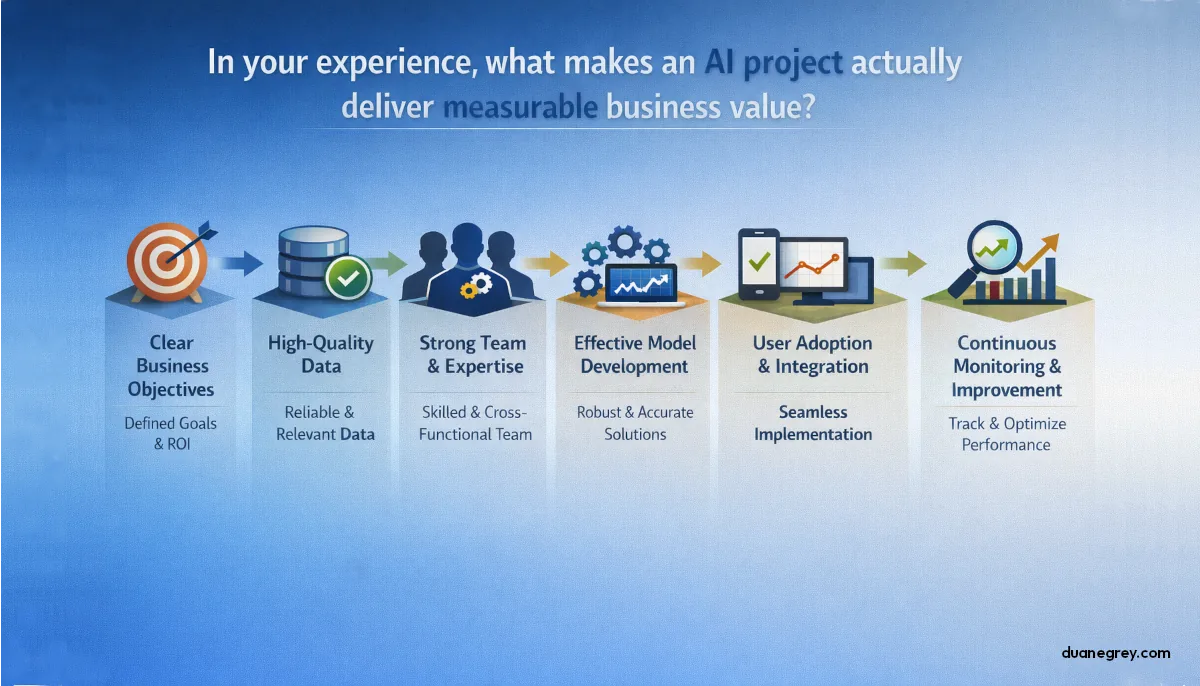
The Short Version
An AI project is still just a project. The question is whether the inclusion of an LLM provides capabilities essential to the project's success. Before writing a line of code, define what success looks like in measurable terms. Pick one of three categories (risk avoidance, cost reduction, or revenue expansion) and pick the specific number that will tell you whether the project worked. Get the definition in writing, agree on a time frame, and account for the full cost including ongoing inference and monitoring.
An AI project is still just a project. The decision to use AI is like any other technology decision. Will an LLM provide capabilities essential to the project's success? If the answer is yes, specific decisions around how to implement AI span security, testing, usage, monitoring, and model choice. But before any of that, you need to answer a more fundamental question. What does success mean for this project? The answer should be specific, measurable metrics that everyone agrees on before the first line of code is written.
Three Categories of Business Value
In my experience, most projects that deliver measurable value fall into one of three categories. Each one requires a different metric, a different justification, and a different conversation with stakeholders.
Risk Avoidance
The business plans to sell services to a new set of companies. As part of that effort, we know they will want to audit our infrastructure. We need to make sure we can pass a HITRUST audit that specifies our data needs to be encrypted in transit and at rest. So you start a project to make sure all application communication (API to database) is encrypted and the storage devices are encrypted as well.
The metric here is binary. You pass the audit or you do not. The business value is access to a market segment that requires compliance certification. Without the project, those deals do not happen.
Cost Reduction
We are currently paying X amount for licensing of an application technology. If we move our applications to use containers, we could deploy on Docker, Kubernetes, or any cloud provider's application hosting plan that supports containers. We then eliminate paying X amount per year, saving the organization Y amount over a specified period.
The metric is the delta between what you spend today and what you will spend after migration, measured over the same time period. The project is justified when the savings exceed the cost of doing the work.
Revenue Expansion
We have customers who have signed a letter of intent to use our services if we deliver specific functionality that will allow them to reduce their costs and improve their revenue. By selling these services, our revenue will increase X amount over a specified period.
The metric is new revenue directly attributable to the delivered capability. The letter of intent is what separates this from speculation. Without that commitment from the customer, you are building on hope.
What You Need Before You Start
Before writing a line of code or evaluating a single model, get alignment on four things.
What are you measuring?
Pick the specific numbers that will tell you whether the project worked. For the HITRUST example, that was a binary pass or fail on the audit. For cost reduction, it was the delta between current licensing spend and projected container hosting costs. For revenue expansion, it was the dollar value attached to signed letters of intent.
If you cannot point to a number before the project starts, you will not be able to prove value after it ships. This sounds obvious, but I have watched projects go into development where the success criteria was "improve the customer experience." That is a goal, not a metric. A metric would be "reduce average response time from 4 hours to under 15 minutes" or "increase first contact resolution rate from 62% to 80%."
Over what time frame?
A project that saves $200K per year but takes 18 months to implement has a different business case than one that saves $50K in 90 days. The time frame also determines how you report progress. A 6 month project needs a midpoint checkpoint. A 12 month project needs quarterly reviews where someone is comparing actuals against the original projection.
Time frame also matters because AI projects carry ongoing costs that traditional software projects may not. Model inference is not free. If you are calling an external API, your cost scales with usage. If you are hosting your own model, your cost scales with infrastructure. Either way, the time frame for measuring success needs to account for those recurring expenses, not just the initial build.
Who agrees on what success looks like?
This is the one that gets skipped most often. Engineering defines success as "the feature works," sales as "revenue increased," and finance as "costs went down." If those three groups are not looking at the same metric before the project starts, you will get a project that technically succeeds and politically fails.
Get the definition in writing. A shared document, a slide in the kickoff deck, an email thread. Something that people can point back to when opinions diverge six months later. The format does not matter; the precision and accessibility do.
What is the full cost?
You need include more than just the build cost. Include the run and manage expenses that follow the project into production. Model hosting, API usage, monitoring tooling, the engineer who will maintain it, retraining cycles if the model drifts.
I have seen projects that looked like clear wins on the build estimate and then lost their margin within a year because the cost model left out inference at production volume. A proof of concept that processes 100 requests per day looks affordable. The same system processing 50,000 requests per day is a different financial conversation entirely.
This is where AI projects diverge from traditional software projects. A conventional application has relatively predictable hosting costs once deployed. An AI system's costs can shift based on model selection, token volume, and whether you are running inference locally or through a third party. Build those variables into your cost model before you commit to the project.
The Underlying Discipline
Whether the value is risk avoidance, cost reduction, or revenue expansion, the four steps are the same. Define what you are measuring. Set a time frame. Get everyone to agree on the definition. Account for the full cost, including what happens after launch.
AI does not change those steps. It adds specific considerations around model costs, monitoring for drift, and security around data flowing through inference pipelines. But the discipline of defining measurable success before you build is what has separated successful technology projects from expensive experiments for decades.
By the Numbers
Only 26% of AI projects move beyond the pilot stage to full production deployment
Gartner, AI in the Enterprise Survey, 2025
Organizations that define success metrics before starting AI projects are 2.5x more likely to report measurable ROI
McKinsey, The State of AI, 2024

Written by Duane Grey
AI Strategy & Implementation
Independent AI consultant helping companies cut through hype and deploy systems that produce real results.