Why do companies struggle to figure out where AI fits in their business?
Find this useful? Share the visual.
The Short Version
The hard part is not the technology. It is the discovery problem. A 2026 INSEAD and Harvard Business School field experiment found that companies given structured frameworks for where to apply AI discovered 44% more places to use it than companies with identical tools and training. Access alone does not close the gap.
Because the hard part was rarely the technology. It's the discovery problem. Most companies have access to capable AI tools. What they don't have is a systematic way to figure out where those tools create value inside their specific operation.
The Mapping Problem
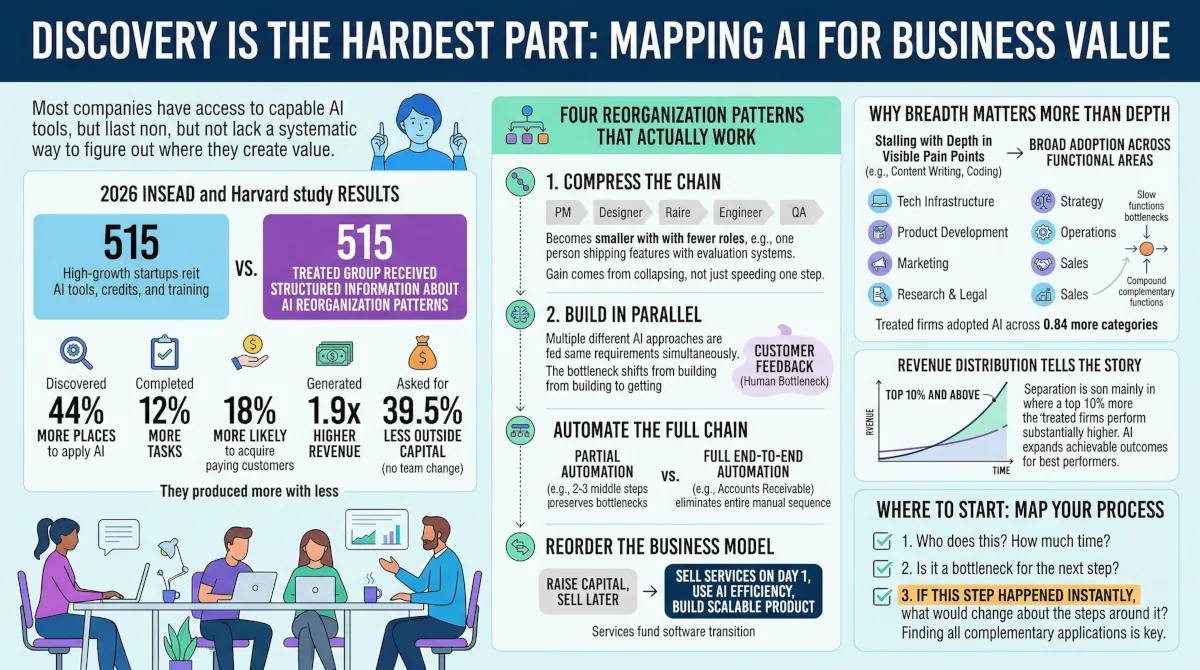
A 2026 field experiment from INSEAD and Harvard Business School studied 515 high growth startups. Both groups received the same AI tools, API credits, and technical training. The difference was that one group received structured information about how other companies had reorganized their production processes around AI.
The group that received those frameworks discovered 44% more places to apply AI in their business. The tools were identical. The difference was how broadly each group searched their own operations before settling on where to apply them.
That gap in discovery led to real performance differences. The treated group completed 12% more tasks, was 18% more likely to acquire paying customers, and generated 1.9 times higher revenue. They also asked for 39.5% less outside capital, with no change in team size. They figured out how to produce more with fewer resources.
Why Access Alone Doesn't Close the Gap
The control group in this study had identical tools and training. They adopted AI at comparable rates across multiple platforms. The gap was in where they applied it and how deeply.
The common pitfall is adopting a handful of AI applications for the most visible pain points (content writing, meeting summaries, code completion) and then stalling. The technology has more capability left. The team just hasn't mapped the rest of the production process to find where AI changes what's possible.
The researchers found that technical background didn't predict who benefited. Non-technical founders gained just as much as technical ones. How broadly you search across your own workflows matters more than how skilled you are with any individual tool.
Patterns That Separated the High Performers
The study population was startups, but the reorganization patterns it documented show up in larger companies too. The structural thinking translates across company size.
Compress the chain. In the study, small teams collapsed sequences spanning multiple roles into fewer steps. In larger organizations, the version that works is compressing handoffs within a workflow rather than eliminating roles. A product team that used to pass requirements through three review stages before development could use AI to generate implementation options during the requirements phase itself, cutting a two week handoff cycle to days.
Build in parallel. Startups in the study ran multiple technical approaches simultaneously and let customer feedback decide the winner. For teams operating inside enterprise constraints (architecture review, security approval, compliance), the move looks different. Instead of building each path, AI can prototype three approaches as lightweight proofs of concept before engineering commits to one. The investment before the decision drops significantly.
Automate the full chain, not just pieces. This one translates directly. One company in the study automated an eight step accounts receivable process end to end. Companies that automated just two or three steps in the middle still needed the same number of people to manage the handoffs. Partial automation changes where the bottleneck occurs. The value came from eliminating the manual sequence.
Rethink the sequence. The study documented startups that reordered their business model entirely, selling services before building product. Inside an established company, the equivalent is questioning whether the current process order is a requirement or just a legacy. Teams that audit their workflow sequence before automating it often find steps that exist because of old constraints that AI has already removed.
Why Breadth Matters More Than Depth
The study classified AI use cases across seven functional areas: technical infrastructure, product development, marketing, research and legal, strategy, operations, and sales.
The companies that performed best applied AI broadly across multiple areas rather than going deep in one. The researchers found that treated firms adopted AI across 0.84 more distinct functional categories on average.
Production works in chains. If AI speeds up product development but operations still run at the old pace, the faster development creates a pileup at the next step. The gains compound across complementary functions; optimizing one in isolation just shifts where the bottleneck sits.
The Revenue Distribution Tells the Story
The revenue gains from this discovery process weren't uniform. Most of the distribution looked similar between groups. The real separation happened in the top 10% and above, where treated firms generated substantially more revenue.
AI expands what the best performers can achieve. The breakouts came from companies that mapped AI broadly across their process, while those that used it well for one task stayed inside the pack.
Where to Start
Before evaluating specific AI tools, map your production process from customer contact through delivery. For each step, ask three questions:
1. Who does this step today, and how much of their time does it take?
2. Is this step a bottleneck that limits how fast the next step can happen?
3. If this step happened instantly, what would change about the steps around it?
The third question is the one most companies skip. Knowing that AI can speed up a task is not the same as understanding what happens to the rest of your process when that task becomes instant. The companies that broke out were the ones who found the applications that needed to change together, not the single best place to start.
By the Numbers
Firms that received frameworks for mapping AI into production discovered 44% more AI use cases and generated 1.9x higher revenue than firms with identical tools and training
Kim, Kim, and Koning, Mapping AI into Production: A Field Experiment on Firm Performance, INSEAD Working Paper 2026/20, March 2026
Capital demand fell 39.5% for firms that mapped AI broadly, while workforce size remained unchanged
Kim, Kim, and Koning, Mapping AI into Production: A Field Experiment on Firm Performance, INSEAD Working Paper 2026/20, March 2026

Written by Duane Grey
AI Strategy & Implementation
Independent AI consultant helping companies cut through hype and deploy systems that produce real results.