Find this useful? Share the visual.
The Short Version
The technology matters less than where you point it. A 2026 Columbia and Peking University study tested the same AI across seven workflows at one company. Results ranged from a 16% increase in sales to a 4.5% decrease. The gains came where AI filled a real capability gap (multilingual support, missing product descriptions), and the losses came where a competent process already existed. Before deploying AI in your business, map your capability gaps first.
Because the technology matters less than where you point it. The size of the gap between what your business currently does and what AI can deliver determines whether you see a return.
The Same Technology, Wildly Different Results
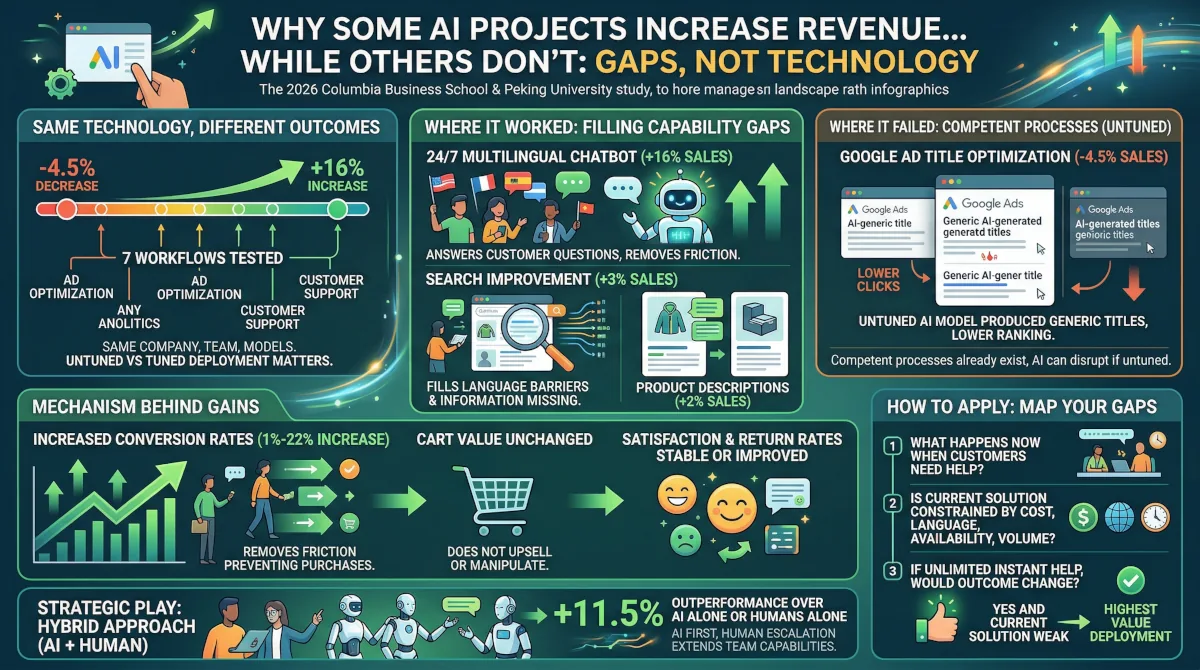
A 2026 study from Columbia Business School and Peking University tested this directly. One company deployed AI across seven different business workflows using the same technical team and the same models. Results ranged from a 16% increase in sales to a 4.5% decrease. The technology stayed constant. The variable was which workflow received the upgrade.
Where the business had a real capability gap, AI filled it and revenue went up. Where the existing process was already competent, AI added nothing or made things worse.
Where It Worked
The biggest gain came from a customer service chatbot. Before AI, shoppers asking questions before buying got an automated message saying no agents were available. The company couldn't afford multilingual human staff for those inquiries. AI covered that gap with round the clock availability across languages, with answers tied to each question. Sales went up 16% for shoppers who used it.
Search improvement added 3% to sales. Product descriptions added 2%. Both filled real gaps on a platform serving shoppers across multiple countries, where language barriers and missing product information were leaving sales on the table.
Where It Failed
Google ad title optimization went negative. The existing human titles were already decent, and the AI model wasn't tuned for advertising. It produced generic titles that Google's algorithm ranked lower. Traffic and sales fell with them.
Deploying AI where a competent process already exists, without tuning for the domain, can hurt performance.
The Mechanism Behind the Gains
Across the workflows that produced positive results, conversion rates increased between 1% and 22%. Cart values didn't change. The gains were new buyers, not larger orders.
AI removed friction that had been preventing purchases. It supplied answers to questions that had no answer, translations for queries the company couldn't read, and product descriptions where products had none. Buying behavior itself stayed the same.
Return rates and customer satisfaction stayed flat or improved, which rules out the possibility that AI was tricking people into purchases they would regret.
How to Apply This
Before choosing where to deploy AI in your business, map your capability gaps. For each customer facing workflow, ask:
1. What happens right now when a customer needs help or information at this stage?
2. Is the current solution constrained by cost, language, availability, or volume?
3. If you could provide unlimited, instant, personalized support at this stage, would it change the outcome?
If the answer to the third question is yes and the current solution is weak, that's your highest value deployment. If the current process is already performing well, AI might not improve it and could introduce new problems if not properly tuned for the domain.
The research showed that a hybrid approach (AI first, human escalation when needed) outperformed both AI alone and humans alone by 11.5%. Full replacement isn't always the goal. Sometimes the highest value play is using AI to extend what your team can already do.
By the Numbers
AI deployments at the same company produced sales effects ranging from -4.5% to +16.3%, depending on the capability gap filled
Fang et al., Generative AI and Firm Productivity: Field Experiments in Online Retail, Columbia Business School, 2026
Across four positive AI deployments, the estimated annual incremental value was approximately $5 per consumer
Fang et al., Generative AI and Firm Productivity: Field Experiments in Online Retail, Columbia Business School, 2026

Written by Duane Grey
AI Strategy & Implementation
Independent AI consultant helping companies cut through hype and deploy systems that produce real results.