How do you decide which business processes are best suited for AI optimization?
Find this useful? Share the visual.
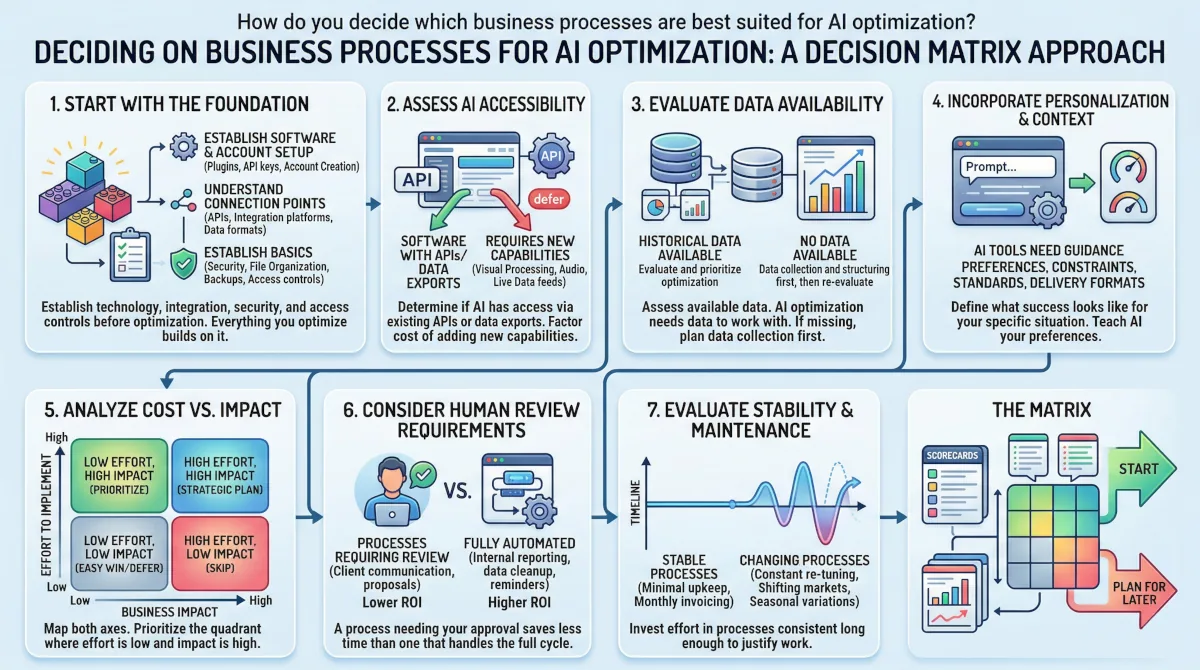
The Short Version
It is not a single decision. It is a matrix of seven factors weighed at once. Start with processes that score well across all of them. Plan for later the ones with gaps in multiple areas.
When I think about this question, it's not a single decision. It's a matrix. You're weighing multiple factors at the same time, and where a process lands across those factors tells you whether to prioritize it, defer it, or skip it entirely.
Start With the Foundation
If you're just getting started with AI, choose the easiest items first. Any introduction of technology has a foundation that needs to be in place before it works. For AI, that means software setup, plugins, API keys, account creation with an LLM provider. If you're planning to integrate that software into existing systems, you need to understand the APIs, the integration platforms in between, and the data formats moving across them. It also means establishing basics around security, file organization, backups, and access controls.
Get this foundation right once. Everything you optimize afterward builds on it.
Can AI Reach the Process?
How much of the optimization lives in a system that AI has access to? If the process runs inside software with APIs or data exports, AI can work with it. If it requires capabilities you don't have yet (visual processing, audio transcription, live data feeds), you need to factor in the cost of adding those capabilities before the optimization is worthwhile.
Do You Have the Data?
AI optimization needs data to work with. If you have history to learn from, you can evaluate quickly whether AI will help. If you don't, set the expectation that collection happens first. AI can help you structure what you're gathering over time. Then you re-evaluate whether the work is worth continuing.
Personalization and Context
AI tools do a lot, but they need guidance on what success looks like for your specific situation. They need to understand how you want something done, not just what. Maybe the output is factually correct but the delivery format doesn't work for your team or your customers. This layer is where you teach the system your preferences, your constraints, and your standards.
Cost vs. Impact
The easiest win and the highest value win are often different processes. Some processes cost you significant time or money but are straightforward to automate. Others are easy to set up but save you ten minutes a week. Map both axes, effort to implement and business impact if it works. Prioritize the quadrant where effort is low and impact is high.
The Human Review Question
Some processes need you to review the output before it goes anywhere. Client communication, proposals, anything a customer sees. Others can run without you, internal reporting, data cleanup, scheduling reminders. That distinction changes your actual ROI. A process that still requires you to approve each output saves less time than one that handles the full cycle. Factor in where human review is necessary and where it isn't.
Maintenance and Drift
Once AI is optimizing a process, how often does that process change? Monthly invoicing is stable. It stays optimized for a long time with minimal upkeep. Responding to shifting market conditions or seasonal changes requires constant re-tuning. Invest your setup effort in processes that will stay consistent long enough to justify the work.
The Matrix
Plot your processes across these factors: foundation readiness, AI accessibility, data availability, personalization needs, cost vs. impact, human review requirements, and stability over time. The processes that score well across the board are where you start. The ones that need work in multiple areas are where you plan for later.
By the Numbers
65% of organizations that have adopted AI report increased revenue in business units where AI is used
McKinsey Global Survey on AI, 2024
Only 11% of companies have scaled AI beyond pilot programs, often due to unclear prioritization of which processes to automate
Accenture Technology Vision, 2024

Written by Duane Grey
AI Strategy & Implementation
Independent AI consultant helping companies cut through hype and deploy systems that produce real results.