Find this useful? Share the visual.
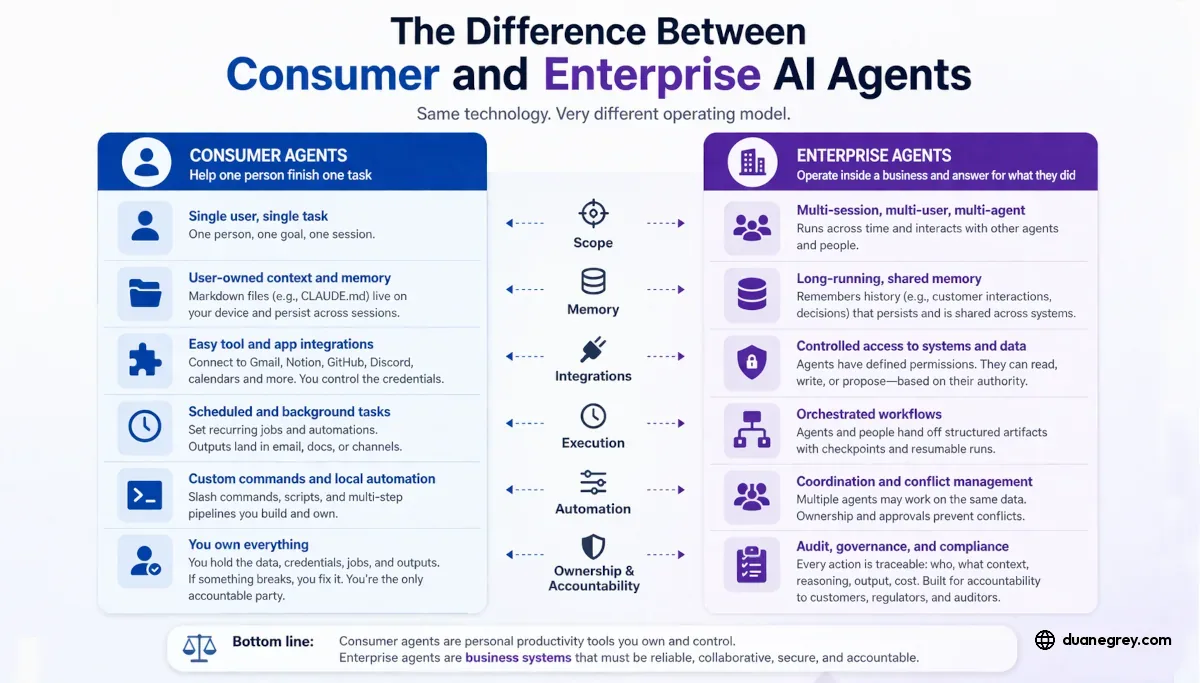
The Short Version
A consumer agent serves one accountable user. An enterprise agent runs across sessions, alongside other agents and people, with shared data and an audit trail. The five places the consumer model breaks are memory, context assembly, coordination, authority, and governance. Each one is a separate engineering problem.
A consumer agent helps one person finish one task. An enterprise agent operates inside a business, across sessions, alongside other agents and people, and has to answer for what it did.
Consumer Agents
The consumer side moved quickly over the last year. A consumer agent used to mean a browser tab and a chat window. That's still the entry point for most people, but a growing segment of users has pushed much further.
At the basic end, consumer agent use still looks like a conversation. You open ChatGPT or Claude, type a question, read the answer, and close the tab. State mostly evaporates at the end of the session. Drafting a proposal, summarizing a PDF, comparing three research options. One person, one task, one session.
At the advanced end, the picture is different. Claude Code, Cowork, OpenClaw, and a wave of similar tools put files, memory, and automation in the hands of individual users.
Markdown as memory. Power users keep a `CLAUDE.md` or equivalent in their project folder. It holds conventions, decisions, pointers to other files, and notes about past work. The agent reads it at the start of every session. A conversation that would have started from zero now starts with a page of context the user curated themselves. The file survives across sessions because it's just a file on disk.
MCP servers and tool integrations. A consumer now wires agents into Gmail, Notion, GitHub, Telegram, Discord, calendars, and their own databases. Credentials get handed over at install time. The agent can read email, create issues, post to channels, and query private data. Many of these integrations are available through a package registry with a one line install.
Scheduled and background tasks. Claude and several competitors added scheduled task features. A consumer can tell the agent to check a mailbox every morning, summarize overnight Discord activity, pull metrics from a site, or run a recurring research prompt. The user isn't in the session when it runs. The output lands in email, a doc, or a channel.
Custom slash commands and skills. Users are building their own slash commands for repeatable workflows. A single command might fetch data, call a model, format the output, and drop it into a destination. It's spreading through YouTube tutorials and public repos.
Multi step local automation. A consumer writes a small pipeline. The script reads an inbox, calls a model, writes to a local database, and posts a summary somewhere. The agent is one step in a chain the user controls. This is not uncommon anymore. Entire YouTube channels exist to teach it.
What stays constant at both ends is the operating model. The user owns everything. The credentials, the context files, the scheduled jobs, the outputs. There is no other person whose permissions have to be respected. No other agent working the same data with different authority. No audit trail anyone else consumes. If the agent makes a mistake, the user sees it and fixes it. If the automation breaks, the user restarts it. The single accountable party is the person at the keyboard.
Enterprise Agents
An enterprise agent operates inside a business and has to survive conditions a consumer agent rarely faces. It runs across sessions, alongside other agents, with real data, and under rules the business is accountable to.
Long running memory. A lead qualification agent needs to know that a specific company asked about pricing three weeks ago, that a follow up email was sent, and that a sales rep logged a phone call in between. The agent doesn't restart from zero every time a new message comes in. The memory persists, and other systems read from the same memory.
Context assembly under token limits. An agent handling a support ticket might have access to thousands of prior tickets, a knowledge base, and the customer's account history. None of that fits into a model prompt. Deciding which five or ten pieces of information go into the context window is a real engineering problem with business consequences. Pull in the wrong history and the answer misses the point.
Coordination with other agents and people. A research agent produces a draft. A review agent checks it against brand guidelines. A human approves the final version. Each step hands off a structured artifact, not a wall of text, because unstructured handoffs degrade at each handoff. The pipeline has checkpoints, so if the review step fails, the run resumes from where it left off instead of starting over.
Authority over shared data. Two agents might both want to update the same customer record. One is the billing agent. One is the marketing agent. If the marketing agent overwrites the billing address without billing's approval, the business has a problem. Enterprise agents need to know what domain they own, what they can read, and what they can only propose.
Audit and governance. Each decision an enterprise agent makes has to be traceable: who asked for the output, what context the agent saw, what reasoning it followed, what it produced, and how much it cost. Those records are what makes the system defensible if a customer, regulator, or auditor asks why the agent did what it did.
The operating environment is many users, many sessions, many agents, and a business on the hook for the outputs. The agent's job is to produce work that holds up under review, coordinates cleanly with other work, and respects the boundaries of who owns what.
Why the Distinction Matters
A power user with markdown memory, scheduled tasks, and a dozen MCP integrations is doing real work. From the outside, that setup can look like a short scale up away from an enterprise system. It is not. The difference is the operating model underneath, not the sophistication of the tools.
A consumer setup, no matter how advanced, assumes one accountable user. The context file reflects that user's decisions. The scheduled tasks run under that user's credentials. The outputs are accountable to the user alone. When an enterprise puts an agent behind a business process, the assumption changes. The agent is touching data owned by different teams, producing outputs that affect customers, spending money the company has to account for, and operating alongside other agents and people with their own authority over the same records. Each of those shifts breaks a different piece of the consumer model.
Memory becomes a shared store multiple agents read and write, with permissions and provenance attached to the data the user can no longer maintain alone. Context turns from a lookup against the last conversation into a retrieval problem across thousands of prior interactions, working under token budgets and confidence cutoffs. Coordination means agents handing off structured artifacts to other agents, with checkpoints that let a failed run resume instead of restart. Authority moves from implicit to explicit, expressed as a registry of who owns what data and who can change it. Governance leaves the terms of service page and becomes an audit trail the business can defend in a review.
Building an enterprise agent is not the same as calling a better model, and it's not the same as giving a consumer setup more tools. The model is one component. Memory, context assembly, coordination, authority, and governance are separate problems, each with their own design decisions. The teams doing this well are building those components deliberately, not assuming the model or the tooling will handle them.
This is the first in a series on what it takes to build agents that operate inside a business. The next posts cover each of the hard problems in turn: memory, context, multi-agent pipelines, orchestration, shared knowledge, and authority. Each one is a place where the consumer model stops working and a different engineering approach has to take over.
By the Numbers
65% of organizations reported regular use of generative AI in at least one business function, nearly double the share from ten months earlier.
McKinsey, The State of AI in Early 2024
By 2028, 33% of enterprise software applications are projected to include agentic AI, up from less than 1% in 2024.
Gartner, 2024

Written by Duane Grey
AI Strategy & Implementation
Independent AI consultant helping companies cut through hype and deploy systems that produce real results.