How do autonomous AI agents improve IT governance and compliance?
Find this useful? Share the visual.
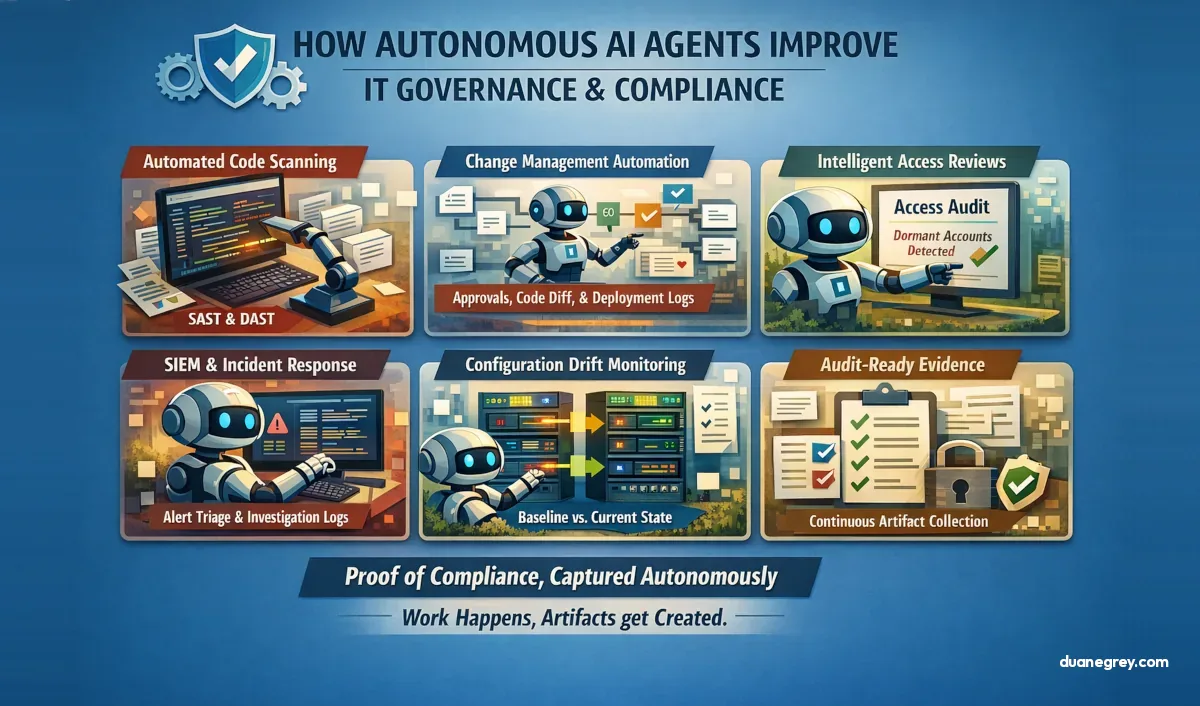
The Short Version
Frameworks like HITRUST and HIPAA do not just require you to have policies. They require continuous proof in the form of scan results, change records, access reviews, and configuration snapshots. The real cost of compliance is maintaining that evidence year round, not writing the policy manual. Autonomous agents capture the proof as a byproduct of work that was already happening, so audit prep becomes running queries instead of running a project.
The word "autonomous" points to a specific problem that most governance frameworks share, the artifact burden.
Frameworks like HITRUST and HIPAA do not just require you to have policies. They require continuous proof that you followed them. The proof takes the form of scan results, change records, access reviews, configuration snapshots, and investigation logs. People accept the policy work as necessary. The complaint, in my experience, is the evidence trail you have to maintain year round.
Organizations often treat artifact generation as separate from the work itself. You do the job, then you document that you did it. That duplication is where autonomous agents change the picture.
Where Agents Fit
Static and dynamic code testing is the clearest starting point. SAST and DAST scans run autonomously on every commit, logging timestamped results, flagging violations, and filing the artifacts without a human initiating them. The scan was already necessary. The agent just makes the proof a byproduct instead of a second task. For HITRUST specifically, this maps directly to vulnerability management controls that require evidence of regular testing across the application lifecycle.
Change management is where the documentation burden intensifies. Every deployment needs to trace back to an approved ticket, with the approval chain, the code diff, and the test results linked together. An agent monitoring that pipeline can generate the change management artifact as the change happens. The approval, the implementation evidence, and the post-deployment validation end up in one record. No one is reconstructing it when someone remembers the audit is coming.
Access review certification is one that drains more time than it should. HITRUST requires periodic reviews of who has access to what, and HIPAA ties access controls directly to PHI protection. The standard process is a spreadsheet sent to managers who have to validate with their employees whether the access is still needed. An agent that monitors IAM, surfaces the last time each account was used, flags dormant accounts, and detects privilege creep transforms that review. Instead of "Do you still need this?" followed by "I think so?", the reviewer sees that an account hasn't authenticated in 90 days and now it's a decision based on data. The agent assembles the evidence package, the reviewer makes the call, and the artifact documents both.
SIEM triage, escalation, and investigation closes the loop on continuous monitoring. HITRUST has controls requiring that security events are detected, classified, escalated, and resolved with documentation at each stage. Most organizations have a SIEM. Fewer can prove they consistently acted on what it found. An agent that ingests alerts, applies triage logic, routes to the right team based on severity, and logs the entire chain produces the investigation artifact in real time. What was flagged, how it was classified, who received the escalation, what actions were taken, what the resolution was. All timestamped. The difference between "we have monitoring" and "we can demonstrate our monitoring process works" is that documentation trail.
Configuration drift detection runs quietly but produces some of the most valuable compliance evidence. Your approved baseline is documented. An agent that continuously compares production against that baseline and logs every comparison produces artifacts whether something drifted or not. A deviation gets flagged and remediated. No deviation gets logged as proof of conformance. Both are audit evidence. For HIPAA, this is particularly relevant to technical safeguards where you need to demonstrate that systems handling PHI maintain their approved security configuration over time.
The Common Thread
None of these agents are making governance decisions. They are capturing proof that governance happened. The policies, the approvals, the human judgment still belong to people. The documentation of those things is what the agent handles.
This matters because the real cost of compliance isn't writing the policy manual. It's maintaining the evidence that you live by it 365 days a year. Teams that produce artifacts as a byproduct of work spend their audit prep running queries instead of running a project.
By the Numbers
Internal staff typically dedicate 200 to 600 hours to evidence collection and remediation work for HITRUST certification
Sprinto, HITRUST Certification Cost Guide, 2026
GRC automation tools can cut manual evidence collection by up to 80%, reaching e1 readiness in as little as 80 labor hours
ComplyJet, HITRUST Certification 2026

Written by Duane Grey
AI Strategy & Implementation
Independent AI consultant helping companies cut through hype and deploy systems that produce real results.