What is the future of the SaaS subscription model amid AI agents that can now perform entire workflows that once required multiple SaaS subscriptions?
Find this useful? Share the visual.
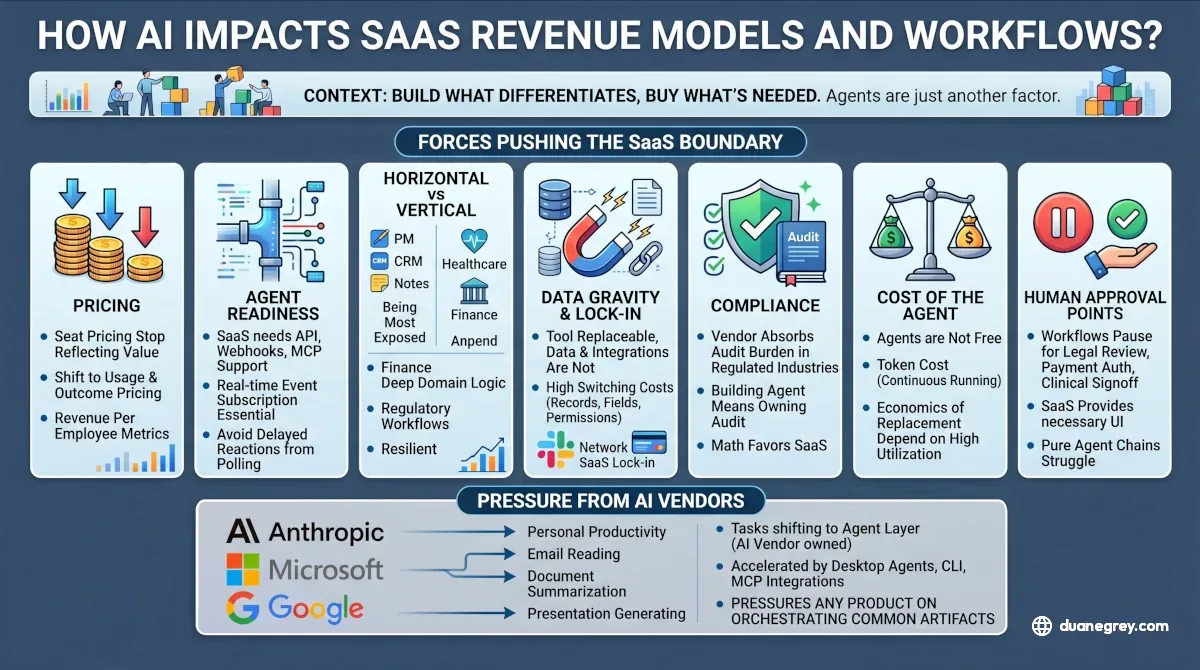
The Short Version
You build what differentiates. You buy what most businesses need. Agents do not break that rule, they shift the line. Generic SaaS that sits on top of common data is where agents compress hardest. Vertical SaaS with deep domain logic, regulatory workflows, or networked data is harder to displace. The build side gets more viable every quarter, though it requires teams willing to own the maintenance and audit that come with it.
When I think about how agents change SaaS, I go back to a decision framework I used for years in architecture. You build what differentiates your business. You buy what most businesses need. That rule kept teams focused on their actual work instead of reinventing accounting, email, or ticketing. Agents do not break that rule. They are just another factor to consider.
Why the Line Moves Slowly
My car has a V6 engine. Three spark plugs are accessible from the front. The other three sit behind the engine. To reach them I have to remove the windshield wipers, the cowl, disconnect hoses, pull covers, then lay across the engine bay. I could do the work and I have the skill, but I still pay the dealer. The friction is high enough that owning the task is not worth it.
Most workflows running in a SaaS platform have a version of that calculation. What is the friction of pulling it out, standing up your own version, and maintaining it once it runs?
Forces Pushing the Line
Pricing. If one person with an agent produces what five used to, seat counts stop reflecting value. Usage pricing, outcome pricing, and revenue per employee as a business metric are showing up in response. Vendors that stay on seat counts will feel the compression first.
Agent readiness. Agents live in APIs and event streams. Most SaaS has an API. Webhook coverage and MCP support vary wildly. If an agent cannot subscribe to what is happening as it happens, it is polling on a schedule and reacting late. SaaS offerings without an integration solution that takes into account real-time events are at a disadvantage.
Horizontal versus vertical. Generic project management, generic CRM, generic notes are the most exposed. An agent with a database replicates much of it. Vertical SaaS with deep domain logic, regulatory workflows, or networked data is harder to displace.
Data gravity and lock in. The tool is replaceable. The historical data, the integrations, and the cost of migration are not. Years of records, custom fields, permissions, existing commitments, and downstream systems create switching costs that have nothing to do with the software itself. For network SaaS like Slack or Stripe, the lock in is that everyone else is already there.
Compliance. In regulated industries the vendor absorbs audit burden. Building it yourself means you own the audit. That math favors SaaS longer than the agent capability alone would suggest.
Cost of the agent. Agents are not free. An agent running continuously has token cost. For low volume tasks the seat license is still cheaper. The economics of replacing a SaaS subscription only work when utilization is high enough.
Human approval points. Some workflows pause on legal review, payment authorization, or clinical signoff. SaaS provides a UI for that moment. Pure agent chains struggle when a person has to step in with context and make a call.
Pressure From a Second Direction
Anthropic, Microsoft, and Google are moving into personal productivity through desktop agents, CLI tools, and MCP integrations. Tasks that used to live in workflow SaaS (reading email, summarizing documents, generating presentations) are shifting to the agent layer owned by the AI vendor. Claude for work, open source alternatives, and the general direction of CLI plus MCP integrations are accelerating that shift. This is not specific to SaaS. It pressures any product category built on orchestrating common artifacts.
Greenfield Companies Start Differently
Teams that are comfortable with agents from day one will delay buying SaaS as long as they can, because revenue per employee goes up when fewer licenses and fewer people do more of the work. Whether they eventually buy depends on how specialized their needs become and whether a vendor closes the gap on their specific workflow.
Which SaaS Survives
The question is not whether SaaS survives. It is which SaaS survives, and in what shape. The ones that own a system of record, a network, or deep vertical logic have room to keep operating. The ones offering a thin workflow on top of common data are where agents compress hardest. And the build side of the equation gets more viable every quarter, but only for teams willing to own the friction, the maintenance, and the audit that come with it.
By the Numbers
By 2028, 33% of enterprise software applications are projected to include agentic AI, up from less than 1% in 2024.
Gartner, 2024
By 2029, 80% of common customer service issues will be resolved autonomously, reducing operational costs by up to 30%.
Gartner, 2025

Written by Duane Grey
AI Strategy & Implementation
Independent AI consultant helping companies cut through hype and deploy systems that produce real results.