Is general mistrust of AI a hindrance to businesses adopting AI for client-facing tasks?
Find this useful? Share the visual.
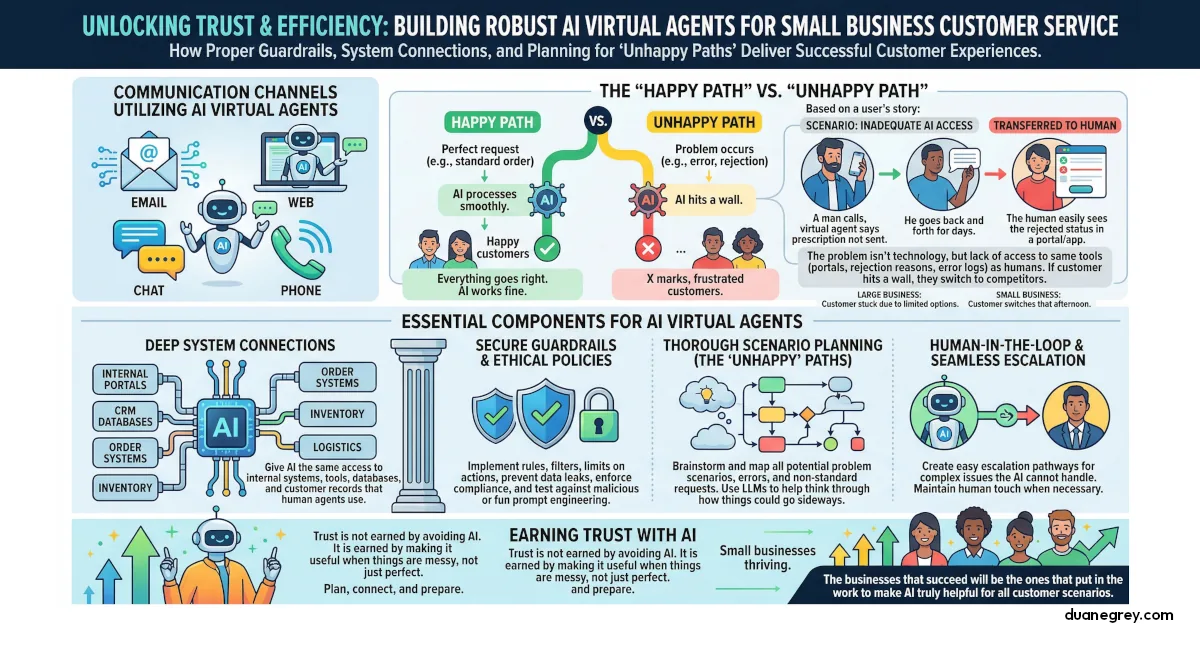
The Short Version
Mistrust of AI isn't what holds businesses back from putting it in front of customers. Poor implementation is. Virtual agents handle the happy path fine and fall apart the moment something goes wrong, because few teams gave the bot the same access and judgment the human representative has. The work is naming what has to be in place before launch, and treating that list as your launch criteria. The businesses that earn trust will be the ones that did that work.
No, I don't think it will be a hindrance if it's done properly.
A Quick Story
My doctor sent a prescription to a large pharmacy chain. They use virtual agents to answer the phone. I called to check if my prescription was ready and the virtual agent told me it hadn't arrived. That wasn't true. It had arrived but was rejected because of an error in the quantity.
I spent days going back and forth between my doctor and the virtual agent, getting nowhere. Finally I asked to be transferred to a human being. That person checked and gave me the real answer in two minutes. The prescription had been rejected and needed to be resubmitted with the correct quantity.
Where It Went Wrong
I doubt the customer service representatives memorize proper quantities for the drugs they handle. There was clearly a portal or application that shows representatives things like errors, rejection reasons, and prescription status. The virtual agent could have had access to the same information.
The problem wasn't that the technology isn't ready. The problem was that the team didn't take the time to give the virtual agent the same tooling and access that the human representative had. It worked fine for the happy path where the prescription arrives perfectly and everything is in order. The moment something went wrong, it fell apart. The bot also didn't notice it was failing.
What You Have to Think About
The pharmacy bot's failure is the same failure most customer facing AI has, and the work to fix it isn't exotic. Here is what matters when you're deciding whether to put a bot in front of your customers, and what to ask the person building it.
Live access to your systems, with limits. The bot has to read the same systems your human rep checks. It also needs limits on what it can change. Reads first. Anything that changes state, like a refund or a cancellation, should require human confirmation.
The bot has to know when it doesn't know. A bot that guesses confidently is worse than no bot. When the data it needs is missing or unclear, the right answer is "I don't see a clean status here, let me get you someone who can dig further." Saying nothing is better than saying the wrong thing.
Escalation should happen before the customer asks. Most systems wait for the user to demand a human. By then the person is already frustrated. A working system notices it has tried the same thing twice without progress and offers to transfer first.
The handoff has to carry the conversation. When the human picks up, they should already have the transcript and what the bot tried. The pharmacy call is the textbook case for what not to do. By the time I got a human, I had explained the situation three times to a bot that had it logged.
Customer tone should drive behavior. Tone shifts during a conversation. A working system reads the words the user is choosing and adjusts when things turn negative. The person who says "this is ridiculous" shouldn't have to repeat herself three more times to get a human.
Guardrails matter. People will try to get your bot to reveal data it shouldn't, or to do things you didn't intend. Some will do it for fun, some will do it on purpose. Plan for both. The bot needs filters on what it accepts as input and on what it returns as output.
Someone has to watch the conversations. Not just when something breaks. Without regular review of the calls the bot handled and the ones it escalated, it's hard to see what's failing until a customer says so publicly.
Test the bot against what goes wrong, not what goes right. Before launch, write down the weird scenarios your human reps have handled. Run the bot through each one. Whatever it fails on is the work you have to do before going live. The happy path isn't where customer trust is built or lost.
Regulated Industries Need More
If you operate in healthcare, finance, legal, or insurance, the rules change. The bot in the pharmacy story is sitting on HIPAA protected information, which means the model provider needs to be under an agreement that covers it. Conversations have to be retained and audited the way the rest of your customer interactions are, and personal information should be redacted before it reaches the model. None of this is exotic. It is the difference between a bot that helps and a bot that triggers a regulator letter. If you are in a regulated space and the person selling you the bot can't explain how each of these gets handled, that is your answer.
Why This Matters More for Small Businesses
I went through that because the prescription was from a specific manufacturer and I had no alternative. I'm their customer because I have to be. Small businesses don't have that luxury. If your customer hits a wall with your virtual agent, they can switch to your competitor that afternoon.
If You Are the One Building It
If you read the list above and your reaction was "and how do I do each of those," that's the right question. It is the subject of the companion piece on this site, What does production AI for customer service include?, which walks through the architecture, the choices that hold up under real traffic, and what to ask if you are evaluating a vendor instead of building it yourself.
The Real Trust Builder
Trust gets built in how the bot handles what goes wrong. Build for that before launch and the happy path will take care of itself.
By the Numbers
72% of consumers trust companies less than a year ago, yet 60% say AI advances make trust more important
Salesforce State of the AI Connected Customer, 2024
Service teams using AI spend 20% less time on routine cases, freeing approximately 4 hours per week
Salesforce State of Service Report, 2025

Written by Duane Grey
AI Strategy & Implementation
Independent AI consultant helping companies cut through hype and deploy systems that produce real results.