What is the biggest mistake people make when using AI to write their sales messaging?
Find this useful? Share the visual.
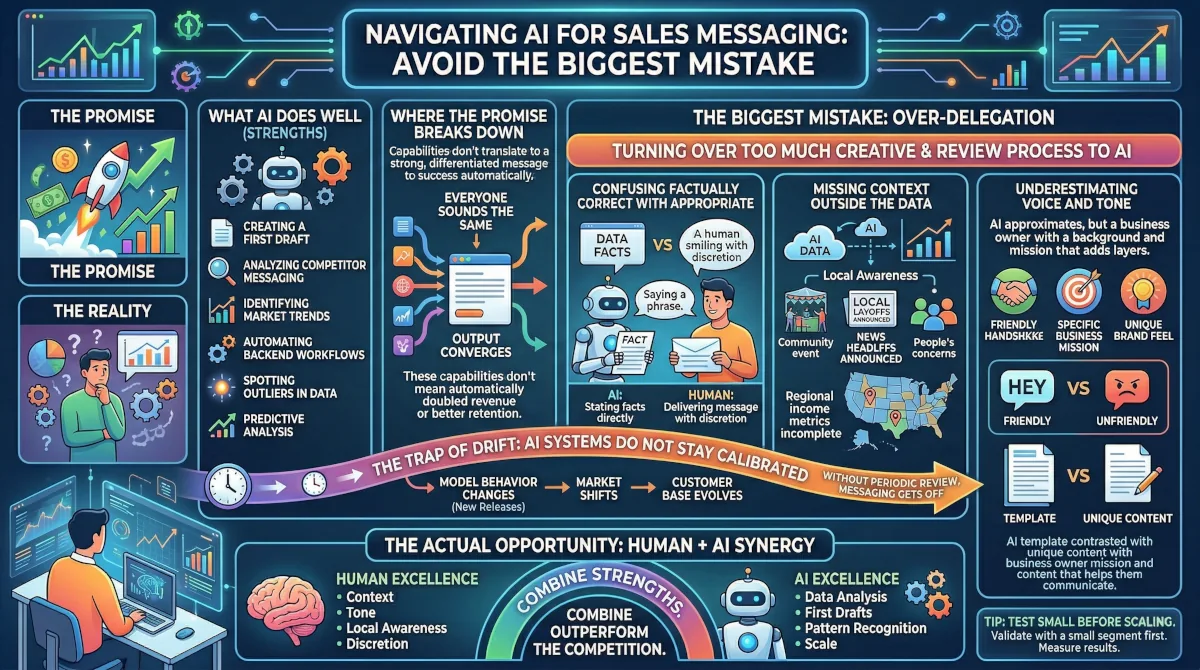
The Short Version
The biggest mistake is delegating too much of the creative and review process. AI is genuinely good at first drafts and pattern recognition. It is not good at sensing context the data does not capture, like a local employer just announcing layoffs, or knowing when something factually correct is the wrong thing to say. Combine what AI is good at with what is local to your business, and test with a small segment before you scale.
When I think about AI writing sales messaging, the conversation usually starts with the same promise. Let AI handle your outreach and watch revenue climb. The work behind doing that well is more involved than the promise makes it sound.
What AI Does Well
Creating a first draft is genuinely valuable. Starting from something is easier than starting from nothing. AI can analyze your competitor messaging, identify trends in your market data, automate backend workflows, spot outliers in large data sets, and do predictive analysis across customer segments. These are real capabilities that save time and surface information you might miss.
Where the Promise Breaks Down
These capabilities do not automatically translate into doubled revenue, better customer retention, or correctly identifying new business opportunities. AI marketing systems are operating across roughly the same data sets as your competitors. When most firms in an industry feed similar data into similar models, the output converges. Your messaging starts blending in with the rest of the field. The differentiation that makes a business memorable comes from what the AI can't source on its own.
The Biggest Mistake: Over-Delegation
The biggest mistake people make is turning over too much of the creative and review process to AI. This shows up in three specific ways.
Confusing factually correct with appropriate. Just because something is accurate in a message doesn't mean it should be delivered that way. If your analysis determines a customer can't afford your product, the AI might state that directly. A human knows to say "let's see how I can help you in an affordable way." The data is the same. The delivery is different.
Missing context outside the data. Will your AI system understand that a major employer in your community just announced layoffs? Will it pick up on the concerns being discussed in local businesses? AI might look at state or regional income metrics and miss that now is not the time to push premium pricing. That local awareness comes from you, not from a model trained on aggregate data.
Underestimating voice and tone. If someone says "hey" you can tell immediately whether it's friendly or not. AI can approximate your industry's messaging conventions and your campaign tone, but dialing it in is an iterative process. There's marketing copy based on your industry, copy based on your market segment, and then there's the factor of a business owner's background and mission that shapes how their company communicates. That last layer is what makes messaging feel like it comes from a real business, not a template.
What Drifts Without You Watching
People set up AI messaging and assume it stays calibrated, but it doesn't. Drift happens in any system. Your model's behavior changes with each version release, and your market and customer base shift alongside it. Without periodic review, the messaging that worked three months ago may be slightly off today and noticeably off next quarter.
The Actual Opportunity
The biggest opportunity isn't replacing your creative process with AI. It's combining what AI systems are excellent at (data analysis, first drafts, pattern recognition, scale) with what humans excel at (context, tone, local awareness, knowing when something technically correct is the wrong thing to say). The businesses that get this balance right will outperform the ones that automate everything and the ones that avoid AI entirely.
Before you scale AI generated messaging to your full list, test it small. A message that reads well and a message that converts are two different things. Validate with a small segment first, measure the results, then expand what works.
By the Numbers
60% of marketers using generative AI for content report concerns about brand consistency and voice accuracy
HubSpot State of Marketing Report, 2024
Personalized sales outreach generates 6x higher transaction rates, but only when messaging reflects genuine understanding of the buyer
Experian Marketing Services, 2024

Written by Duane Grey
AI Strategy & Implementation
Independent AI consultant helping companies cut through hype and deploy systems that produce real results.