Find this useful? Share the visual.
The Short Version
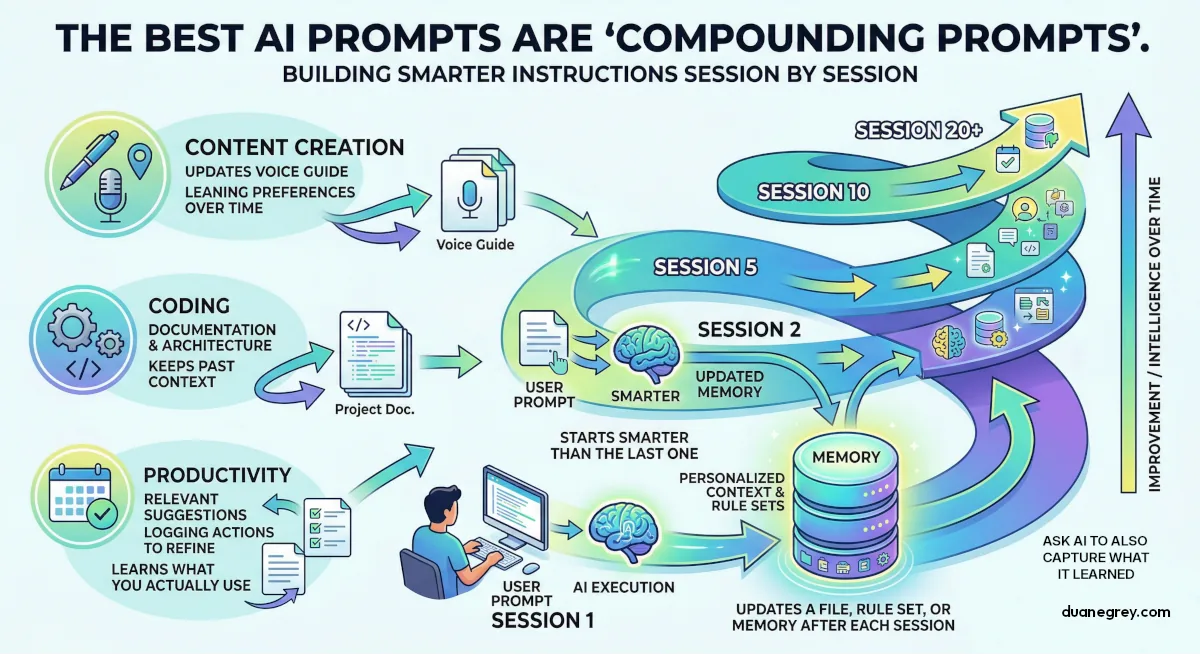
The best prompts are not clever instruction sets you copy from a list. They are compounding prompts that update a file, rule set, or memory after each session so the next one starts smarter. A regular prompt gives a good output once. A compounding prompt builds on what happened before, with each use.
The prompts that have made the biggest difference for me aren't clever instruction sets you copy from a list. They're prompts that get better with each use.
Compounding Prompts vs. Regular Prompts
A regular prompt gives you a good output once. A compounding prompt updates a file, a rule set, or a memory after each session so the next session starts smarter than the last one.
The difference matters because most people write a prompt, get a result, and start from scratch next time. Compounding prompts build on what happened before.
The concept is simple. Instead of just asking the AI to do something, you ask it to also capture what it learned about how you work, then feed that back into the instructions for next time.
How to Build One
Talk to your AI about your situation first. Describe what you're trying to accomplish, how often you do it, and what frustrates you about the current process. Let the AI help you design the prompt. You don't need to engineer the perfect instruction set yourself. The AI is good at structuring its own instructions when you give it the context.
Three Examples from Different Areas
Content Creation
I run a prompt at the end of each content session that reads through the conversation, identifies patterns in how I write, what edits I made, what I rejected, and updates a voice guide file. That voice guide becomes the instruction set for future content.
Early on, it captured that I prefer colons over dashes. A few rounds later, that I catch overstatements before the AI does. By round twenty, the AI drafts content that needs minor cleanup because it learned my preferences over time.
The key instructions:
- Scan the session for drafts, feedback, phrases rewritten, and rules stated during editing
- Extract new rules, voice refinements, what worked, and what needed reworking
- Update the voice guide file so the next session starts with everything this session learned
Software Development
I use a prompt at the end of development sessions that reviews what was built, what decisions were made, what patterns were followed, and updates the project documentation. The next session starts with full context on architecture choices, naming conventions, and lessons from past mistakes.
Instead of re-explaining my codebase each time, the AI already knows why things are built the way they are.
The key instructions:
- Update memory with architectural decisions, bugs fixed, completed features, and file paths that changed
- Document lessons learned: debugging approaches, quirks discovered, patterns that emerged
- Write a handoff summary for the next session with what's completed, what's in progress, and open questions
Productivity and Task Management
After completing any significant task, the AI presents three categories: actions it can handle right now, systems it can set up so the task no longer needs to be done manually, and messages it can draft for your team.
It compounds by logging which suggestions you act on and which you skip. Over time, the suggestions get more relevant because they're shaped by what you've historically found useful, not just what seems logical in the moment.
The key instructions:
- Present next actions, automations to set up, and tasks to delegate with draft messages
- Log which suggestions were acted on and which were skipped
- Use that history to prioritize future suggestions by what you've found useful
What Ties Them Together
Across the three examples, the same thing happens. The prompt does the work AND captures something that makes the next round better. That's what separates an instruction used once from one that becomes part of how you operate.
By the Numbers
Structured prompts with context produce outputs that are 40% more aligned with user intent compared to zero-shot prompts
Microsoft Research, Prompt Engineering Best Practices, 2024
67% of professionals using AI tools report spending significant time re-explaining context in new sessions
Salesforce AI at Work Survey, 2024

Written by Duane Grey
AI Strategy & Implementation
Independent AI consultant helping companies cut through hype and deploy systems that produce real results.