Find this useful? Share the visual.
The Short Version
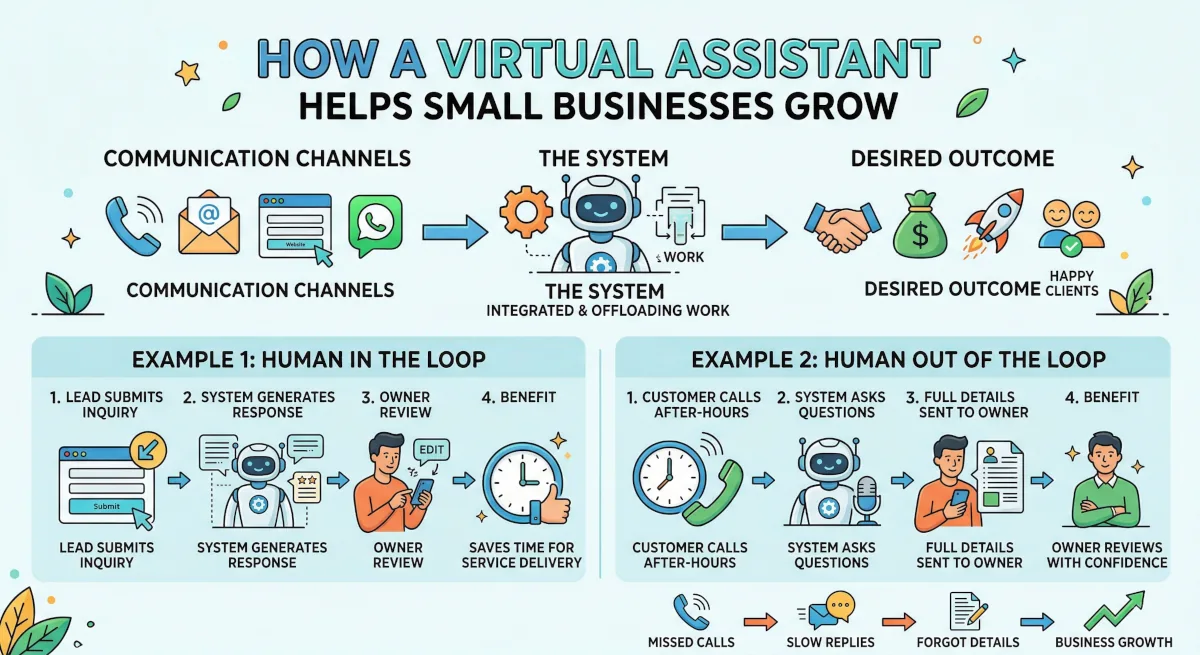
A virtual assistant offloads communication and coordination so you can focus on delivering your actual service. Each implementation follows the same structure. A communication channel feeds a system that produces an outcome. The real design choice is how much human review sits in the middle. Pick the channel that causes you the most friction today and build there first.
A virtual assistant offloads communication and coordination work so you can focus on delivering your actual service.
The Common Structure Across Virtual Assistant Use Cases
Before jumping into specific tools, it helps to understand the general design. Each virtual assistant implementation follows the same structure. A communication channel connects to a system that produces a desired outcome.
The channel might be a phone call, a website form, an email, or a text message. The system processes that input. The outcome is either a completed action or a summary ready for your review.
What changes between implementations is how much human involvement you want.
Human in the Loop
A lead submits a form on your website. The system compares their inquiry against your services, matches it with a relevant response that includes what you provide, general pricing, and a customer testimonial they can look up. That draft response is sent to your phone. You review it, edit if needed, and send. The customer gets a thoughtful reply in minutes instead of hours.
You stay in control of each message. The system does the research and drafting, and you make the final call.
Human Out of the Loop
Someone calls your after hours number. Instead of taking a basic message, the system asks follow up questions to capture context about their problem. The output is a structured summary sent to you with enough detail to take action when you're ready.
No one waited on hold, and no one left a vague voicemail. The system gathered what you would have asked anyway.
Why the Design Matters More Than the Tool
I kept this framework generic on purpose. Some businesses run on Google Workspace, others use Office 365, Slack, or WhatsApp. The structure stays the same. A communication channel feeds a system that produces a desired outcome.
Once you see how the pieces connect, you can evaluate whether your current tools support the integrations you need. The virtual assistant is the system in the middle, not a specific product.
Where to Start
Pick the communication channel that causes you the most friction. For most service businesses, that's either responding to inquiries or capturing information from phone calls. Build the system for that flow first. The foundation you create carries over when you add the next one.
By the Numbers
64% of small businesses use at least one AI tool for customer communication
U.S. Chamber of Commerce, 2024 Small Business AI Survey
Businesses using automated response systems report 37% faster response times to customer inquiries
Salesforce State of Service Report, 2024

Written by Duane Grey
AI Strategy & Implementation
Independent AI consultant helping companies cut through hype and deploy systems that produce real results.