Find this useful? Share the visual.
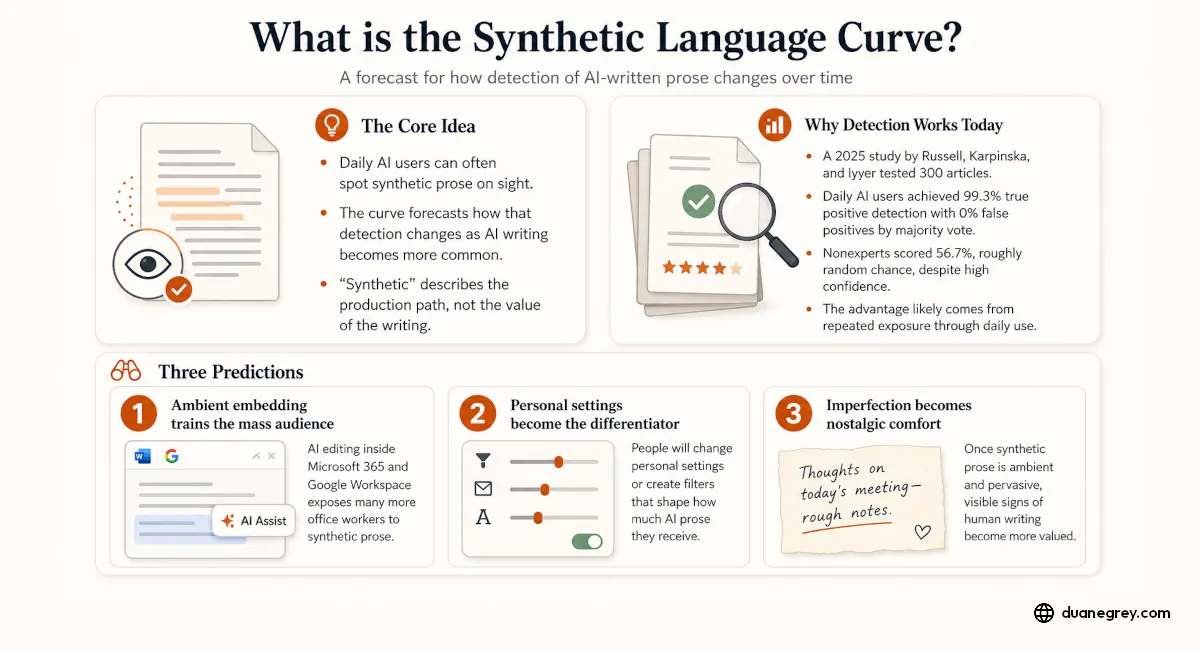
The Short Version
The Synthetic Language Curve is a forecast of how detection of AI prose moves over time. Detection peaks today, where daily AI users score at or near 99% on controlled detection studies. The mass audience gets passively trained next, by AI assistance shipping on by default in Microsoft 365 and Google Workspace. The personal settings layer becomes the actual arms race. Eventually, deliberate imperfection becomes a kind of nostalgic comfort the way handwriting did after print became cheap.
Most people who use AI for writing every day can spot AI prose on sight. They cannot always prove it, and the automated detectors are unreliable enough that arguing over a specific piece is usually wasted effort. The skill is real. It is harder to talk about than it should be, because the people who have the skill are mostly the people doing the writing, and the people who lack it tend to assume few others have it either.
That is the current moment, and I am interested in how this change in communication will impact the future.
By the time the broader population catches up to daily AI users on detection, the curve has already moved past its peak. What comes next is where the curve gets interesting. AI writing assistance becomes invisible infrastructure, the mass audience gets passively trained, the personal settings layer becomes the actual battlefield, and imperfection itself starts carrying weight. I have started thinking of this arc as a single curve with a name. I call it the Synthetic Language Curve.
What the Synthetic Language Curve Names
The curve is a forecast about how detection of synthetic language moves over time. The y-axis measures detectability of synthetic language. The x-axis tracks sequence, not calendar time. The curve rises sharply to a peak that is roughly where we are today, then crashes through a long plateau as ambient embedding makes the signatures common enough to disappear into background noise. A second smaller peak forms above the plateau, much later, as deliberate imperfection becomes its own marker.
A note on terminology before going further. "Synthetic language" in linguistics already means something specific. It is a language with a high ratio of morphemes to words, like Latin, Russian, Turkish, or Finnish. That is a different sense from the one in this piece. Here, "synthetic" carries the sense it does in synthetic biology or synthetic materials, where it means manufactured rather than natural, morally neutral. AI prose is synthetic because a model generates it. The word does not imply it has less value, just that the production path differs from prose a person wrote.
The curve has six positions:
- Position 0: Pre-arc. The "AI will write everything" optimism that pre-dated detection.
- Position 1: Detection peak. Where we are now. The tells are visible, the conversation is loud, and the skill is real and unevenly distributed.
- Position 2: Ambient embedding. AI suggestions get accepted without conscious noticing, on by default in productivity suites.
- Position 3: Personal settings split. The slice of users who can spot the tells tunes the assistance off; the defaults rule everyone else.
- Position 4: Invisible infrastructure. Synthetic language is ambient and unremarked, the way spellcheck became.
- Position 5: Imperfection as comfort. Above the curve, separate from the adoption sequence. The cultural counter-aesthetic, where deliberate imperfection that carries the human hand becomes a nostalgic comfort.
Position 5 sits above the curve because it is not part of adoption at all. It is a layer that forms on top of position 4 after adoption has run its course.
Detection Works Today Because Synthetic Prose Has Signatures
In 2025 Russell, Karpinska, and Iyyer ran a controlled study. Five people who use AI for writing tasks daily scored 300 articles for whether each was generated by AI or written by a person. The majority vote across the five scored 99.3% true positive rate at 0% false positive rate. The same study tested nonexperts, people who rarely use LLMs, and they scored at 56.7%, which is random chance. The nonexperts rated themselves 4.03 out of 5 on confidence in their own judgment. The experts beat most commercial automated detectors tested in the study. The skill comes from daily use of AI, which is itself a form of training.
What the experts use is a working catalog of tells. Some are vocabulary. Particular words appear more often in AI output than in human writing. Sentence structures recur, like the list of three, the "not only this but also that" cadence, the optimistically vague closing. Names show up repeatedly; in one slice of the data, 63% of GPT-4o articles named a character Emily or Sarah. Some tells are grammatical. AI prose tends to be too clean, with the kind of perfect punctuation that human writing under deadline rarely has. The cumulative effect is the part you can spot at a glance but find harder to point at one sentence and prove.
Position 1 is what we can measure today. The rest of this piece is what happens next.
Prediction 1: Ambient Embedding Trains the Mass Audience Passively
In Microsoft's Q2 FY2026 earnings call on January 28, 2026, Satya Nadella reported 16.1 million paid Microsoft 365 Copilot seats against a base of 450 million commercial M365 subscribers, with 12 million daily active users on Copilot itself. The paid seats more than doubled year over year. Gmail and Google Docs have AI assistance on by default in their newest tiers. Outlook and Word surface Copilot suggestions inline as people write.
Office workers have this technology by default. It will be easy to accept most of what the assistance suggests, editing some of it, and shipping the result. The people reading and editing AI prose every day are no longer just the population of professional writers and the LLM enthusiast crowd. The set now includes a meaningful slice of staff at companies running Microsoft 365 or Google Workspace.
The detector population is expanding without anyone signing up for the training. Repeated daily exposure to AI prose at work is doing the training instead. Within a few product cycles, the people who can spot AI writing will include enough senior IT, finance, legal, and operations staff that the assumption "the audience cannot tell" stops being safe to make.
There is a second order effect worth naming. The slice of users who turn the AI assistance off is not random. They are turning it off because they can already spot the tells and do not want their own writing to have the telltale signs of AI influence. Turning the assistance off is a downstream consequence of the skill rather than a cause of it. The expansion of detection across the broader audience and the contraction of usage inside the opt out slice are happening at the same time. The outcome is two tiered.
Prediction 2: Personal Settings are the Differentiation
This is the position on the curve where I have been living for six months.
I keep a voice guide that names the forms my writing takes and the AI tells I want eliminated. Those include hyphenated compounds in prose, dashes used as connective tissue, the "this is not X, this is Y" rhetorical structure, three parallel sentences with the same opener, the word "testament," and several dozen more. I have a command in my AI tooling that pulls voice patterns from each content session and updates the guide. Before drafting anything that will use AI I load these rules into memory. The model has the guide, the content rules, and the antipattern list, and the first pass is already constrained against the patterns a fresh model would default to. After the draft I run a manual scan for the items the model missed on the first pass. The items do regenerate across drafts, user edits, and each time the model is updated.
The personal settings layer is what differentiates how the output sounds. The model is not the variable I am tuning; the settings around the model are. Each product update ends up testing how well my voice and content guideline system operates. There is an ongoing struggle between users and the default AI settings shipping in tools.
Time will tell how many people decided to implement systems such as mine. The people who skip it will keep producing prose that sits closer to the average of the internet. The people who run it will produce prose that keeps their distinct voice, and the gap between the two will become legible.
Prediction 3: Imperfection Becomes a Nostalgic Comfort
The current state and the first two predictions are anchored in things you can measure today. This one is the part of the curve that has not arrived yet.
Once synthetic prose is ambient and pervasive, writing that visibly indicates human involvement will gain value. Typos and lowercase that once read as sloppy start to read as warmth. The em dash without spaces, once a textbook AI tell, becomes deliberate again, because the people using it know what it once meant and use it to say something different now.
The historical analogue is handwriting after the rise of print. Mass typography made type cheap and uniform, and for most purposes that is what people use. But the places where the human hand still gets shown have not gone away. Wedding invitations still come in specialized typography that sits closer to handwriting than to a standard font. Etiquette still says you send a handwritten note after a gift or a visit. These are current norms. The personal, slightly imperfect version carries warmth that mass production cannot deliver. Print made handwriting meaningful. Cheap uniform type created the conditions where the deliberate handwritten version became something people sought out.
Photography shows the same arc. After the era of filters, raw and unfiltered images became their own category, sought out because polish had removed something. Music followed the same path, with vinyl after CDs. The cleaner version becomes the default and the original fades into background. People eventually come back to the rough one, because the polished version lost something it carried.
When the same move arrives for prose, the markers will be small and the people seeking them out will be deliberate. A conversational tone, cultural references, and humor delivered in a unique way will stand out because they read as human.
What I Am Not Claiming
Most of this piece is a prediction. The "Detection Works Today" section is the part most directly backed by research. The three Predictions that follow are my best guesses, based on what happened with similar tools before. The shape of the curve is an argument I am making, not something I measured.
There is one scenario I am not trying to predict. If models eventually produce prose with no detectable signatures, the detection skill goes away with it. The personal settings layer no longer differentiates one voice from another, and imperfection loses its meaning as a marker of human involvement. The claim holds for as long as AI prose carries detectable signatures, which is today but might not be forever. The Russell paper saw current AI attempts to sound more human get caught by their experts. That is where we are today. The threshold could move.
Some people will turn the AI assistance off, others will not. I expect a split, but the ratio is genuinely unknown. The slice of people who can spot the tells might be 5% of office workers, or 20%. That ratio determines whether deliberate imperfection becomes a real market or stays a subculture.
The handwriting comparison is an analogy. Whether prose follows the same path is still open. Sometimes markets refuse to develop a counter-aesthetic. I think this one will, because we have seen the same setup produce one before. A polishing tool becomes the default, and people eventually miss the rougher version. That is my argument. It is not a guarantee.
What to Watch For
The curve moves on indicators, not calendar dates. Three things worth tracking.
The first is when AI rewrite stops being an option in productivity suites and becomes the default. The current state has Copilot and Smart Compose suggestions surfacing inline, accept on tab. The "Ambient Embedding" to "Invisible Infrastructure" transition begins when "rewrite this for me" stops being a button and becomes what happens automatically as you type.
The second is when "AI detection" stops being a software category. Today AI detector tools are sold as products because spotting AI prose is still hard for most people. When that market collapses, it will be because enough people can do it themselves that no one needs to buy the tool anymore. That is also when the people who can spot AI prose stop being an informal group and become a recognized one.
The third is when a public figure adopts deliberate imperfection and gets credit for it. When that becomes the headline in a major business publication, position 5 (imperfection as comfort) stops being a forecast. It is a current event.
I wrote about the daily work that makes the personal settings layer possible in a separate insight, how-to-match-ai-content-to-your-voice. That piece covers the four layers I use to catch AI drift before it ships. This piece predicts where it is heading; that one shows what doing it looks like today.
By the Numbers
Five people who use AI for writing daily scored 99.3% true positive rate at 0% false positive rate when judging 300 articles for AI authorship. Nonexperts scored at 56.7% (random chance) while rating themselves 4.03 out of 5 on confidence in their own judgment.
Russell, Karpinska, & Iyyer, 'People who frequently use ChatGPT for writing tasks are accurate and robust detectors of AI-generated text,' arXiv:2501.15654v2, 2025
Microsoft reported 16.1 million paid Microsoft 365 Copilot seats and 12 million daily active users on Copilot itself, against a base of 450 million commercial M365 subscribers. Paid seats more than doubled year over year.
Microsoft Q2 FY2026 earnings call, January 28, 2026

Written by Duane Grey
AI Strategy & Implementation
Independent AI consultant helping companies cut through hype and deploy systems that produce real results.