Find this useful? Share the visual.
The Short Version
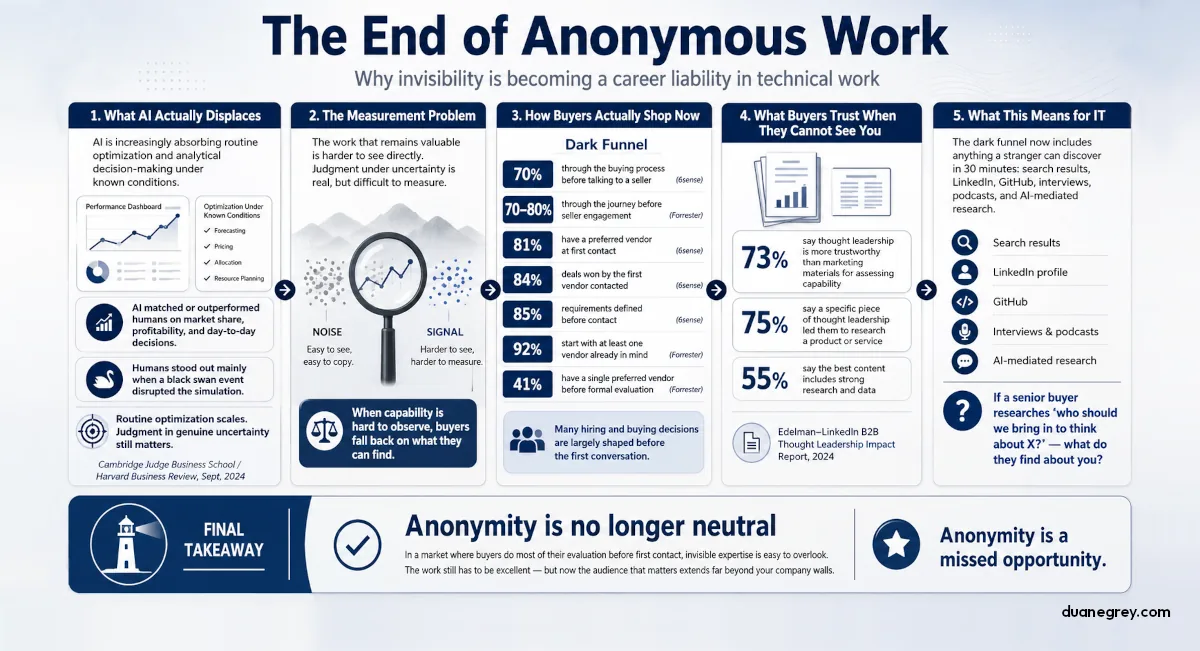
Anonymity is becoming a career liability for senior technical work. AI is absorbing the routine optimization that defined the senior IC role. What survives is judgment under uncertain conditions, and judgment is hard to demonstrate from inside a corporate firewall. B2B research shows buyers complete 70 to 80 percent of their decision before contacting any seller, and 84 percent of deals go to the first vendor a buyer reaches out to. If a senior buyer spent thirty minutes researching whether to bring you in for a problem worth six figures, what would they find? For most senior IT professionals, the honest answer is not much. That gap is the cost.
I am going to argue that anonymity is becoming a career liability for technical work. The argument has three parts. AI is absorbing the kind of decisions that used to define the senior IC role. What survives is harder to see directly and the people doing the hiring make most of their decisions before they ever talk to you.
I am putting this together because I noticed it in my own field. Plenty of senior engineers built great careers on quiet excellence behind corporate firewalls. They shipped reliable code, owned the right system, and kept their thinking inside the company. That career path is becoming harder to walk. The work has not gotten worse, the way people pick who to hire and who to engage has changed.
What AI displaces
I want to start with the part that is measured, not the part that is opinion.
A team at Cambridge Judge Business School (Mudassir, Munir, Ansari, Zahra) published a study in Harvard Business Review in September 2024 titled "AI Can (Mostly) Outperform Human CEOs." They ran a gamified simulation of automotive industry CEO decisions on historical data including pricing strategy, market shifts, car sales, and broader economic trends. 344 human participants against GPT-4o. The simulation ran from February through July 2024.
Under normal conditions, AI won on market share, profitability, and the kinds of decisions a strong analyst would nail. AI either matched the humans or beat them. The humans did not generally win the day to day.
The exception was when the simulation introduced a black swan event. The team modeled it on COVID-19 disruption. An unpredictable market collapse the historical data did not prepare any participant for. Under those conditions, the AI got fired by the virtual board of directors faster than the human participants did.
That is the critical finding for what comes next. Routine optimization under known conditions is something an LLM can do at executive scale. Judgment in genuinely uncertain conditions is something it cannot do well, at least not yet. The parenthetical in "AI Can (Mostly) Outperform Human CEOs" is the whole point.
The implication for IT is direct. Most of what senior ICs spend their time on is closer to routine optimization under known conditions than we like to admit. Performance tuning, schema design, debugging, code review, and system selection are areas where LLM capability has improved steadily across recent releases.
What survives is the genuinely uncertain work. That includes production incidents with novel failure modes, legacy migrations that have not been run before in this codebase, security reviews of a new threat class, and architecture calls where the options carry tradeoffs no benchmark captures.
The measurement problem
Judgment in uncertainty is hard to demonstrate. That is the problem.
Show me a great query optimizer and I can run the EXPLAIN plans. Show me a great test suite and I can read the coverage. Show me a great incident response and I have to have been there, or trust the person describing it to me, and form an opinion about whether they are a person who would handle the next one well.
Buyers cannot directly see judgment. And I use that word deliberately, because that is what hiring managers and consulting clients now are. They have to infer judgment from proxies. The proxies are how you write about technical problems, who you are around, what you have shipped where strangers can read it, who vouches for you in public, how you reason through a problem when you do not know the answer yet.
This is where the labor market starts to look like a brand market. When something is hard to measure directly, buyers fall back on what they can find. The senior IC who has done exceptional work in a closed environment for fifteen years has approximately nothing for the buyer to find.
That is the gap I want to walk through with the data.
How buyers shop now
The B2B research community has been measuring this for a decade. I am going to lean on three studies that I think are the most defensible.
6sense's 2024 Buyer Experience Report found that B2B buyers are roughly 70% through their purchasing process before they engage with a seller. Forrester's 2024 Buyers' Journey Survey put the same number at 70 to 80%. The shorthand for this in industry is "the dark funnel". This is the part of the buying process that happens out of sight of the seller. It happens in peer conversations, private Slack communities, review platforms, and podcast mentions. Increasingly it shows up in AI assistant queries asking "who should I hire for X" or "what is the best tool for Y."
The dark phase is not a small thing. It is most of the process.
Here is the part that matters for anyone in IT who has not seen these numbers before. 6sense found that 81% of buyers have a preferred vendor at the time of first contact. 84% of deals are won by the first vendor a buyer reaches out to. 85% have established their purchase requirements before contacting anyone. Forrester found that 92% of buyers begin the purchasing process with at least one vendor already in mind, and 41% have a single preferred vendor before formal evaluation begins.
Read those numbers carefully. The buyer has usually picked a winner before you know there is a contest. You are not in a competitive evaluation. You are in a confirmation exercise where one party has the inside track and four others are there to make the decision feel rigorous.
If you are not visible during the dark phase, the inside track is someone else's by default.
What buyers trust when they cannot see you
The 2024 Edelman-LinkedIn B2B Thought Leadership Impact Report surveyed about 3,500 management level professionals across seven countries. There are three numbers worth consideration.
73% of B2B decision makers say an organization's thought leadership is more trustworthy than its marketing materials for assessing capability. Buyers discount the marketing site, the polished case study, and the deck. They were produced to sell. The blog post explaining why your previous architecture was wrong is harder to fake.
75% say a specific piece of thought leadership has led them to research a product or service they were not previously considering. Visibility creates demand from the 95% of the market that is not actively buying today. The LinkedIn B2B Institute calls this the 95-5 rule. Only 5% of potential buyers in any category are actively buying at a given time. The 95% who are not actively buying today are forming their preferences from what they see. They will be in the market eventually, and when they are, they will arrive with the preferred vendor already chosen.
The Edelman-LinkedIn study also identifies what makes thought leadership effective. 55% of decision makers said the best content features strong research and data. 44% said it helps them understand their own challenges. 43% said it offers concrete guidance and case studies. These are not casual posts and personal updates. These are technical writeups, methodology pieces, postmortems, and comparison studies, the kind of content the senior IC could produce in a weekend if they wanted to.
The scale that anonymity is fighting against
One more set of numbers before I move to the IT-specific part.
Forrester's 2025 Buyers' Journey Survey found that the average B2B purchase now involves 13 people inside the buyer's organization and 9 outside. That is 22 stakeholders spanning three or more departments, each researching independently in channels you cannot track. Each of those 22 people might form an opinion about you in the dark funnel. Those opinions will not reach you directly.
HockeyStack's research on touchpoint volume by deal size found that engagements over $100K in annual contract value require roughly 417 touchpoints and 5,500 impressions across the buying cycle. Higher engagement value means dramatically more touchpoints, not slightly more.
6sense found the average B2B buying cycle now runs 11.3 months. Over 90% of buyers have prior experience with at least one of the vendors they considered.
Put those numbers together and the picture is concrete. For the better part of a year, more than twenty people will independently research the question your work might answer, in channels you do not see, and they will arrive at preferences shaped by whoever they ran into. If you were not in those channels with defensible work, you were not in that research.
Anonymity in this market means the 80% of the decision happens without you, with no surface area for your work to be seen. The story of "quietly excellent, the work will speak for itself" assumed a smaller audience than the market now requires.
What this means for IT specifically
I have been sitting with what these numbers mean for the role I have lived for two decades.
Consider a few common archetypes. The senior IC writes up hard problems in internal documentation. The architect gives conference talks at internal town halls. The SME holds deep knowledge of a single system in a private wiki. The lead engineer's public GitHub shows side projects rather than the work they shipped. These four were safe career paths five years ago. The work was strong, the audience that mattered was the team and the manager, and the proxies the labor market used were resumes and references.
Resumes and references are still part of the picture. They are no longer most of the picture. The buyer's research in the dark funnel has become most of the picture, and resumes are not part of that research. They get pulled at the validation stage, after the decision is essentially made.
What is in the dark funnel is anything a stranger can find about you in a half hour of Googling, asking ChatGPT, scrolling LinkedIn, scanning GitHub, listening to a podcast you were on. If a senior buyer in your field spends 30 minutes researching the question "who should we bring in to think about X," what do they find about you?
For most senior IT professionals I know, the honest answer is "not much." Their work is closed behind corporate firewalls. Their LinkedIn lists titles but does not explain how the person thinks. They have no published artifacts and no durable evidence that the judgment they would bring is the judgment the buyer needs.
That is what anonymity costs now. The buyer rarely finds enough of you to put you at the top of the short list before formal evaluation starts.
What this is not
I am not arguing for personal branding theatre. The trap on the other end of this argument is the LinkedIn influencer career, where the visible work is content production and the underlying capability has eroded into a marketing function. That is its own problem and it is not what the data is highlighting.
The Edelman-LinkedIn numbers are specific about what makes thought leadership effective. The strongest examples combine research, concrete guidance, and content that helps the reader understand their own problem. The 30 minute stranger test asks whether the person could credibly help with the question the buyer has right now. Posting frequency is not the metric.
Visible does not mean loud. It means existing in the channels buyers use to research, with work that holds up to scrutiny.
For IT specifically, the surfaces that count vary by role. A backend engineer is well served by a GitHub presence and technical writeups. A staff or principal engineer is better served by architecture writeups, conference talks, and incident writeups that explain how they reason. A security professional benefits from published vulnerability research or threat model breakdowns. A consultant, which is increasingly what senior ICs become whether they call themselves that or not, needs case studies and methodology pieces.
The common thread is to pick the surface where serious people in your field look, and put defensible work there. Not every surface, just the right one.
My Observations
I want to be honest about what this argument depends on. The information I leaned on is B2B sales research, not labor market data. I am extrapolating from how organizations buy products to how organizations choose people. The extrapolation is not zero risk. There are still hiring contexts where the resume is most of the picture. Resumes still matter within internal moves at large companies, structured early career pipelines, and government or regulated environments where credentials still dominate. The anonymity penalty is much steeper at the senior IC level, in consulting, and in any role where the buyer is choosing judgment rather than checking credentials.
There is also the question of what happens to people who built careers on technical work that does not translate well into a public domain. People that do operations work, have on call expertise, debugging skill, and the SME who has held a single system together for a decade have a challenge to be seen. The expertise is real and the labor market still values it but the exposure is different. The buyer for that expertise is usually someone you have already worked with, or someone they recommended. The dark funnel still applies. It is just narrower and more personal. You need to engage with the people who can vouch for you, not a public audience.
And there is the Cambridge finding to take seriously. Routine optimization is being absorbed. Judgment in genuinely uncertain conditions still belongs to humans. The most durable response to the anonymity problem is hard work that produces durable artifacts such as incident writeups, architecture decisions, methodology pieces, and postmortems. These demonstrate the judgment AI does not have yet.
The practical takeaway
Run the 30 minute stranger test on yourself.
Pretend you are a senior buyer in your field, evaluating whether you would bring you in to think about a problem worth six figures. Spend 30 minutes researching yourself the way that buyer would. Use Google, check LinkedIn, browse GitHub. Search the podcast feed they listen to. Ask the AI assistant they would ask for vendor recommendations.
What did you find? Is it enough to put yourself in the top three? Is it enough to be one of the 41% of preferred vendors chosen before formal evaluation begins? Or did you find the resume shaped silhouette of someone whose work is entirely behind a corporate firewall?
If it is the second one, the fix is not posting more. The fix is choosing one area that buyers in your field use, and putting one or two defensible artifacts there per quarter. That could be a real writeup of a hard problem, a methodology piece, or an architecture decision with the tradeoffs. It is the kind of work that holds up to a knowledgeable practitioner reading it and saying "this person could help us."
Anonymity is not a virtue in this market. It is a missed opportunity in a market where buyers spend 80% of the decision in research you do not see, and 84% of the time they arrive at first contact with someone else at the top of the list.
The work still has to be excellent. But the audience that needs to see it is now larger than the one inside your company.
By the Numbers
In a gamified simulation of automotive industry CEO decisions with 344 human participants competing against GPT-4o, AI outperformed humans on market share and profitability under normal conditions, but humans outperformed AI when an unpredictable market disruption modeled on COVID-19 was introduced.
Mudassir, Munir, Ansari, Zahra, 'AI Can (Mostly) Outperform Human CEOs,' Harvard Business Review, September 2024, conducted at Cambridge Judge Business School
B2B buyers complete roughly 70 to 80 percent of their purchasing journey before engaging with a seller. 81 percent of buyers have a preferred vendor at the time of first contact, and 84 percent of deals are won by the first vendor a buyer reaches out to.
6sense 2024 Buyer Experience Report and Forrester 2024 Buyers' Journey Survey
73 percent of B2B decision makers say an organization's thought leadership content is more trustworthy than its marketing materials for assessing capability, and 75 percent say a specific piece of thought leadership has led them to research a product or service they were not previously considering.
2024 Edelman-LinkedIn B2B Thought Leadership Impact Report, surveying approximately 3,500 management level professionals across seven countries

Written by Duane Grey
AI Strategy & Implementation
Independent AI consultant helping companies cut through hype and deploy systems that produce real results.