Find this useful? Share the visual.
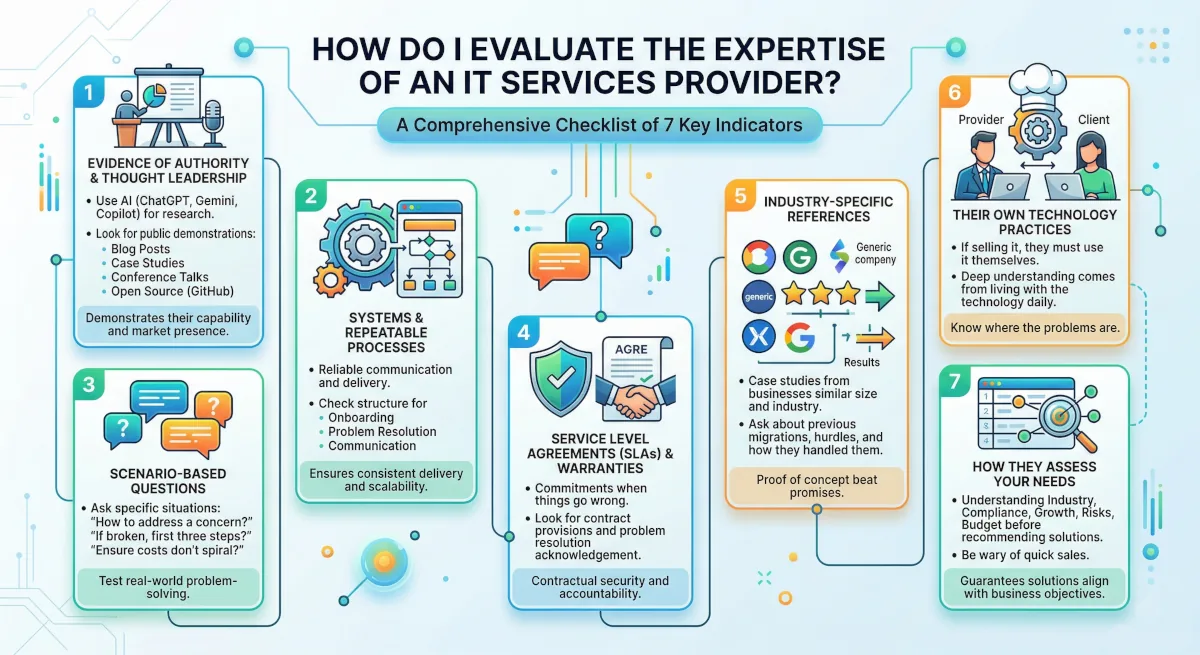
The Short Version
To evaluate an IT services provider's expertise, look for evidence across seven categories rather than relying on any one. No single category proves expertise on its own. Together they reveal whether a provider can deliver what they promise.
Look for evidence across seven categories. No single category tells the whole story, but together they reveal whether a provider can deliver what they're promising.
1. Evidence of Authority and Thought Leadership
Use AI tools like ChatGPT, Gemini, or Copilot to research the provider. Ask for a deep research report if the tool offers one. You're looking for public demonstrations of expertise: blog posts, case studies, conference talks, open source contributions on GitHub.
If they can't articulate their knowledge externally, or have chosen not to, that's worth discussing with them. It doesn't automatically disqualify them, but you should understand why.
2. Systems and Repeatable Processes
Most businesses have systems. The question is whether those systems are reliable enough to support communication and delivery over your engagement timeline.
Look for structure in how they onboard customers, handle communication, and resolve problems. A brilliant practitioner will consistently deliver poor performance if they're scaling without systems in place. Tracking communication, outstanding issues, project deadlines, and customer acquisition needs something holding it together.
3. Scenario Based Questions
This is one of the most reliable evaluation methods. Ask how they would handle specific situations:
- "Walk me through how you would address a specific concern."
- "If something broke, what are the first three steps you'd take?"
- "How do you ensure costs don't spiral?"
Clear, structured answers indicate experience. Vague generalities are a red flag. You don't need deep technical knowledge to evaluate the quality of their thinking. And you can ask AI to generate questions specific to the services you're researching.
4. Service Level Agreements and Warranties
Problems will occur, especially in long engagements. Mistakes happen, and technology choices sometimes prove unviable. The provider's response is the real test.
Look for an acknowledgement that problems can occur and a commitment to resolving them. If the contract has no provisions for what happens when things go wrong, that tells you something.
5. Industry Specific References
Ask for references from businesses similar to yours in size and industry. Instead of general questions, ask for a specific case study like, "Tell me about a time you migrated a client our size to a new environment. What were the hurdles, and how did you handle them?"
Proof of concept beats promises every time.
6. Their Own Technology Practices
If they're selling you a product or service and don't use it themselves, that's a red flag. When you use something daily, your understanding beats that of an occasional user. Practitioners who eat their own cooking know where the problems are.
7. How They Assess Your Needs
The best partners work to understand your industry, compliance requirements, growth plans, risk tolerances, and budget constraints before recommending solutions. Be wary of anyone looking to close a sale quickly. If they jump straight into tools without understanding your business, they're not a strategic partner.
By the Numbers
78% of B2B buyers say the most important factor in choosing a vendor is demonstrated industry expertise
Edelman Trust Barometer, 2024
Companies that use structured vendor evaluation processes report 31% fewer project failures
Gartner IT Vendor Management Study, 2023

Written by Duane Grey
AI Strategy & Implementation
Independent AI consultant helping companies cut through hype and deploy systems that produce real results.