How can companies ensure they can safely distribute modern AI tools and increase productivity?
Find this useful? Share the visual.
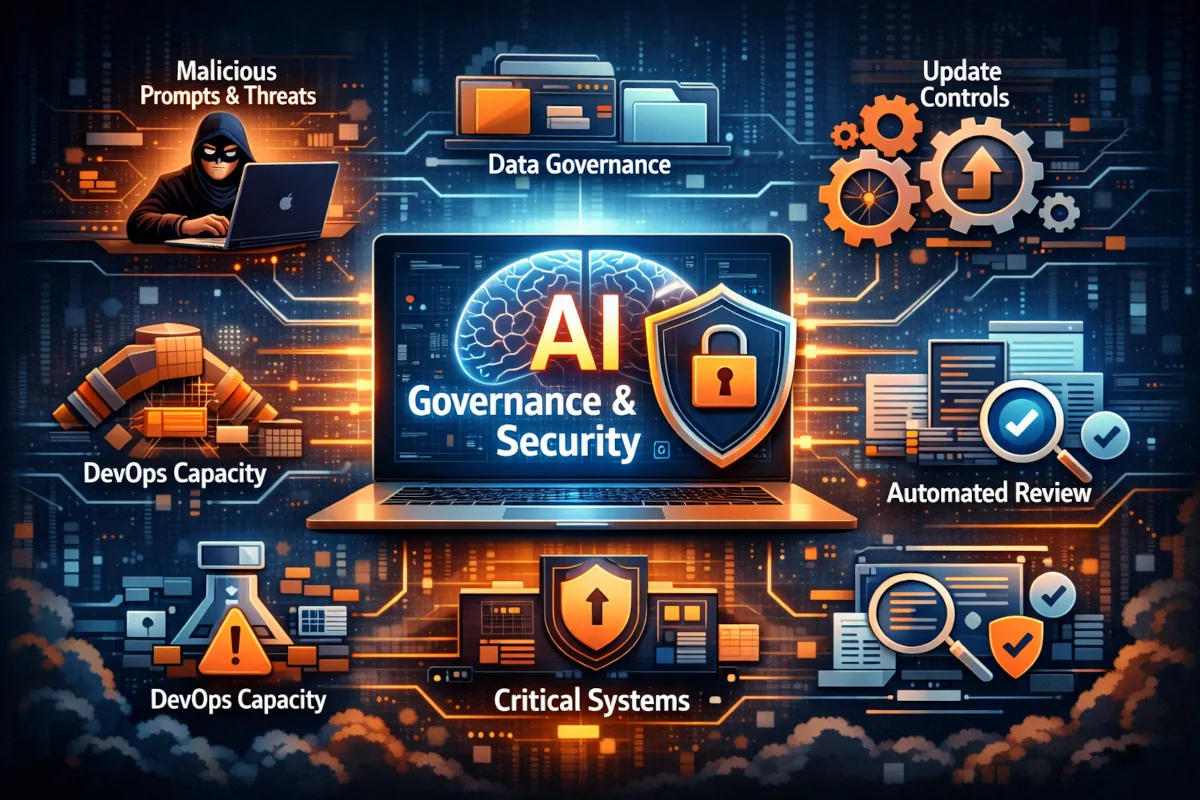
The Short Version
The tool is the easy part. Governance and capacity planning around it are where the real work lives. Treat external prompts and skills like external code with the same vetting process. Set boundaries on what data goes into an LLM. Plan for downstream load on testing, security scanning, and code review so the productivity gain reaches the whole engineering organization at once, not just the people writing code.
The question isn't about the tools. It's about what happens around them. The productivity gains are real, but so is the fallout when adoption outpaces the systems meant to contain it.
Treat External Prompts Like External Code
There have already been documented cases of malicious workflows and agent skills distributed through GitHub that embed hidden characters. When an LLM processes these, it treats the hidden instructions as a request from the user. That can mean downloading malware or exfiltrating data without anyone realizing the prompt was compromised. External prompts, skills, and workflows need the same vetting process as any other dependency your teams pull in.
Data Governance Boundaries
Teams need to know what data they're allowed to put into an LLM and what stays out. Enterprise agreements with providers like Anthropic, Microsoft, and Google typically include provisions for data residency and training exclusion, but the specifics vary by contract. If your teams don't know what the agreement covers, the default behavior is to paste whatever gets the job done. That's where leaks start.
Update Cycle Control
AI tools are moving fast, and that includes breaking changes. At scale, you want to control when tools update rather than letting each developer run the latest version the day it ships. A staged rollout gives you time to catch issues before they hit production workflows.
Downstream Capacity Planning
This is the one most organizations miss. More code produced by AI tools means more testing, more security scanning, more reviews, and more load on your DevOps pipelines. If you hand each developer a tool that doubles their output but don't scale the systems around them, you just moved the bottleneck. The productivity gain needs to be delivered across the entire engineering organization at the same time, not just to the people writing code.
Redlines at Critical Systems
Some systems warrant tighter access than others. For critical infrastructure, you might restrict tools to generating predefined blocks through approved templates rather than producing entire features. Others might stay fully manual. The decision should be based on the cost of a mistake, not the potential for speed.
Automated Review Pipelines
The idea that developers will carefully check each change produced by an AI tool sounds reasonable for about a week. Then delivery pressure kicks in and reviews become rubber stamps. The more sustainable approach is building iterative automated checks into the pipeline: security scanning, architecture guideline adherence, code complexity analysis, and dependency auditing. Human review still matters, but it should be the last gate, not the only one.
Where the Real Work Lives
The tool is the easy part. The governance, the guardrails, and the capacity planning around it are where the real work lives.
By the Numbers
69% of cybersecurity leaders have evidence employees use unauthorized public AI tools at work
Gartner Cybersecurity Survey, 2025
The average cost of a data breach reached $4.88 million in 2024, with AI-related security incidents increasing 40% year over year
IBM Cost of a Data Breach Report, 2024

Written by Duane Grey
AI Strategy & Implementation
Independent AI consultant helping companies cut through hype and deploy systems that produce real results.