Find this useful? Share the visual.
The Short Version
AI sovereignty is a property of the firm, not the nation. It gets decided in architecture, by which parts of the stack a company controls and which it rents. Five pillars carry the question. Learning, continuity, data, measurement, and orchestration. On each one the minimum sovereign position is portability, and a company that reaches at least that on all five is an AI Sovereign Organization.
AI sovereignty for a single company is decided in architecture, by which parts of its stack the firm controls and which it rents.
That is a different question from the one in the press. Sovereign AI there means national compute. Government GPU programs, residency law, a country deciding it wants a frontier model of its own. States are working that out on their own timeline, and it makes for good headlines.
The firm level version is being decided quarter over quarter. It is the sum of ordinary procurement choices, each made for capability or speed, and rarely for whether what the vendor now controls could leave. The June restrictions on Fable made it concrete for anyone running production work on a model they do not host. I watched reactions move from "we need sovereignty" to "which platform gives us that." The second question asks a vendor to supply the ability to leave it.
Two Questions Inside Sovereignty
Most people treat sovereignty as one question, own it or rent it. That single question is most of why the conversation stalls.
A firm buys an enterprise memory product outright, holds a perpetual license, and runs it on hardware it owns. Owned, by any accounting definition. Then the license turns out to permit running the product only inside the vendor's own runtime, or the tuned artifacts the firm's data produced are licensed for use with the vendor's models, or the right to run at all lapses when support does. The firm owns the software and rents the permission to use it.
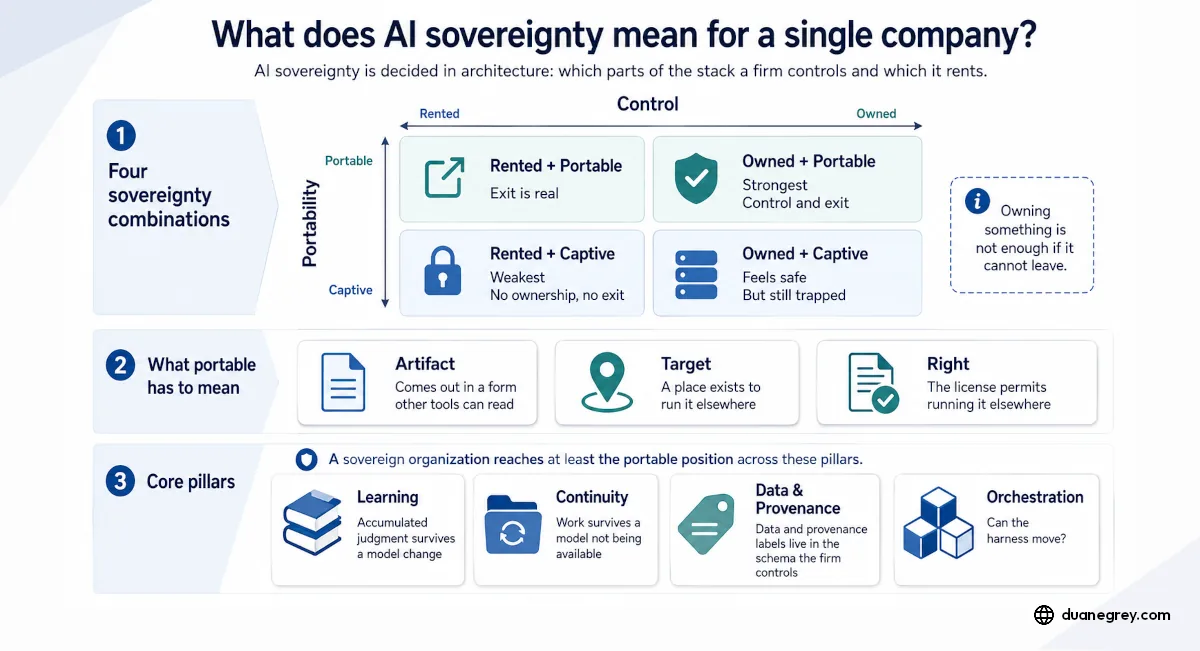
The purchase needs two questions. Who operates it, answered by owned or rented. Whether it can move, answered by portable or captive. They are independent, so a firm can own something outright and still have no way to take it elsewhere.
Four combinations fall out. Owned and portable is the strongest position and the most work. Rented and captive is the weakest, no ownership and no exit. Rented and portable is weaker than owning it, but the exit is real. The last, owned and captive, is the one that fools people, because owning feels like safety and few firms check whether what they bought can leave.
So the minimum sovereign position is portability. Reaching it does not require owning the stack. It trades vendor management and support contracts for engineering and design discipline, plus the diligence to confirm migration is possible.
What Portable Has to Mean
When I say portable, I mean three things. Miss any one and the purchase is not portable.
The artifact. It comes out in a form other tools can read. A memory store the firm can dump, the test cases it grades models against with the traces that feed them, workflow definitions in files, routing config. If the export produces a proprietary blob nothing else ingests, this condition failed.
The target. Somewhere exists to run it that the firm can acquire. Any major cloud, or internal infrastructure that can be bought rather than commissioned. This is the condition that gets missed, because the export works fine and there is nowhere to put what came out. Containers are the strongest answer here, for reasons I have written about separately.
The right. The license permits running it elsewhere once the relationship ends. Can artifacts derived from the firm's own data be used with another vendor's models, does the software run outside the vendor's runtime at all, and does the right to run survive the end of the subscription.
Seat counts, capacity tiers, and the rest of ordinary license metering are IT scalability planning, and I keep them out of the sovereignty question. This condition asks only whether the thing runs somewhere else at all, and whether what your data produced comes with it.
The artifact and the target are technical facts. The license is a contract that renews. A firm can pass all three today and fail at the next renewal even though nothing technical changed, which makes the license the one condition with an expiry date.
The Test Is the Platform Swap
Satya Nadella's article about the future of the firm argues that companies build two kinds of capital, human and token, and that the real opportunity is a learning loop on top of models where the two compound. Then he offers a test:
"A company should be able to switch out a 'generalist' model without losing the 'company veteran' expertise built into their learning system. This is the key 'test' of your control and sovereignty in the era ahead."
What it does not say is where the loop runs. It names three things a firm has to build for itself. Private evals measured against outcomes that matter to the business, training environments where a model improves by practicing against real traces from inside the organization, and a knowledge base that makes institutional memory queryable. Those are the components that decide whether a firm passes his own test, and the article leaves their venue open. It does not say if they run on the firm's infrastructure or a platform's, or if what they produce can be exported.
Expect a vendor to answer that unstated question in the platform's favor. That is ordinary commercial behavior, and it leaves the reader to answer it instead. Can you swap the platform, not just the model? If the learning loop runs inside one vendor's cloud, you pass the model swap test only within that vendor's platform. By his own argument the loop is the new IP of the firm, and whatever the paperwork says, IP that cannot leave the landlord's building is rented.
The Five Pillars
An AI Sovereign Organization is one that reaches at least the portable position on all five of these. The test for each is the same. What survives the swap, and is there somewhere to put it?
Learning
The firm's accumulated judgment has to survive a model change. I call this model portable learning, and the other four pillars are what keep it yours.
In practice judgment reaches a model through system prompts, retrieval from a knowledge or memory layer, and a fine tune for some tasks. The sovereign home for the accumulated version is the layer, provenance tracked and readable by whatever model answers today, so it survives a swap. Fine tuning is the route that can trap it, though only when the tuned weights are applied to a vendor's model the firm cannot take. Even then the training data, kept provenance tracked, lets the firm retune elsewhere, which makes the data the asset to keep, not the weights.
That layer does not have to be self hosted to count. It has to meet the three conditions above. A memory store the firm can dump, somewhere to reload it, and the right to use what its own data produced elsewhere. A vendor hosted memory that clears all three is a better position than a bought product that clears one. If the answer to "where does our accumulated judgment live" is a vendor feature with no export path, migration means amnesia.
Continuity
Continuity asks whether anything the firm runs survives a model being taken offline. The routing decision is the artifact here, and it is usually already written down somewhere as a cost optimization, because sending cheap work to cheap models is how most teams first build a router. The same layer that saves money is what lets a workload fail over when a provider restricts, deprecates, or withdraws a model. Owning the routing configuration is a small piece of work with an outsized return the week you need it.
Data and Provenance
Trust and access labels have to travel with the data through each derivation. A summary of an untrusted document is untrusted, and so is anything derived from it further down the line. Trust degrades through a pipeline and it does not upgrade, which means the label has to move with the record. For that to work, the labels have to live in storage the firm controls, where they stay attached to its data. Kept in a vendor's own store, they stay behind when the firm moves its data, and it is left with records but no way to tell what is trusted or where any of it came from.
Measurement
The firm decides what counts as better. Public benchmarks measure a model against the general case, while private evals should measure against the outcomes that make the business money. The artifact is the eval set plus the traces that feed it. The compliance evidence sits here too, and it gets discovered late. Audit trails, decision logs, and eval records have to survive vendor exit, because a regulator asking for evidence of how a system behaved in March does not care that the vendor holding the logs is no longer under contract.
Orchestration
Orchestration is the newest layer to become a sovereignty question, so it is the one that gets missed. Continuity asks whether the firm can swap the model. Orchestration asks whether it can move the harness. A firm can own perfect failover routing and still be trapped inside a vendor's agent runtime, which is captivity with good uptime.
Orchestration on its own means whatever agent building tool comes to mind. It is made up of five components, each with an artifact that either leaves with the firm or does not:
- Workflow and agent definitions. The business logic: prompts, step sequences, what each agent is for. Portable form is code and config in the firm's own repository. Rented form is logic authored as GUI state inside a vendor console, with no export or an export nothing else runs.
- Tool contracts. How agents reach systems. Written against an open protocol, one tool surface serves any model. Written in one vendor's proprietary function calling syntax, each integration gets replumbed on migration.
- Executor and runtime. The deterministic code that runs plan steps, holds credentials, and enforces gates. Portable form is code the firm hosts, where credentials never enter a model's context. Rented form is a closed runtime acting on the firm's behalf with vendor brokered credentials and an action log in someone else's cloud.
- State. Task and session state, checkpoints, intermediate artifacts. Portable form is a store with a schema the firm can dump.
- Delegation rules. Which agent or tier handles what. Portable form is explicit policy in config the firm edits. Rented form is an opaque router the firm can neither inspect nor move.
Those five run as one loop. A request arrives, the workflow definition frames it and a model proposes a plan, delegation rules assign the steps, the executor runs each step through the tool contracts while holding the credentials, and state records what happened. Sold together, the five look like a single product. Taken apart, each one has an obvious portable form.
Orchestration is also where the other four pillars meet at runtime. The executor consults the router for which model serves a step, reads and writes the memory layer, carries provenance labels through each hop because it is the thing moving them, and emits the traces the private evals consume. Lose this pillar and the other four degrade with it. Migration is when the firm finds the memory it owns can only be reached through a vendor runtime, and its evals are fed by logs it cannot export. Both are owned and captive. That dependency is my answer to the objection that orchestration is just software integration. Integration connects systems the firm already controls. This layer decides whether its learning, measurement, and provenance stay portable or fall to the vendor.
A Note on Agent Identity
There is a good argument that agent identity belongs in a framework like this one as a pillar of its own, with per task minted credentials for each agent. I think it mostly folds into the executor above, and much of what gets discussed as dynamic credentialing does less than the marketing implies.
The authority that mints a credential is itself constrained at design time. A token service that can only ever issue read scoped access is a vault holding a static read credential, with one more service to attack. Dynamic minting earns its complexity where runtime variables narrow the effective scope below that design envelope. A help desk agent serving arbitrary customers is the clear case, since the envelope is any customer's records and the per task grant is one customer's. For a fixed function agent, an ingestion job or a single repository worker, pre provisioned scoped access wins on simplicity.
A token carrying the task and the requester makes the resource layer's own logs record the chain, which is better evidence than reconstructing it from application logs a compromised component could have written. Ephemeral tokens also shrink the window a leak is useful for, which is an economics argument rather than an architectural one.
Neither of those makes identity a separate pillar. Much of what agent identity is sold to solve is what a firm already gets by owning its executor and separating the model that plans from the code that acts, which is the design I have argued for elsewhere. Firms buy the credential product when their runtime is a black box they cannot put a deterministic gate inside. Owning component three is the cheaper route to the same containment.
Where the Portability Argument Is Weakest
The strongest version of the counterargument comes from the applied AI layer. It exists because driving agentic workflows inside an enterprise is genuinely complex, and firms need that help now, on the timeline they already operate on. Bring it in house sounds like advice for the top slice of engineering organizations. A model neutral applied vendor is itself a source of portability, though one the firm rents rather than owns. For many firms that trade beats building the capability in house.
I think that's right, and it doesn't undo the argument. Portability was the minimum position on purpose, and a portable vendor meets it. The question to put to that vendor is the one the three conditions generate. When the contract ends, what leaves with us, where does it run, and are we allowed to run it there? A vendor with a good answer is selling portability. A vendor without one is selling convenience, which is a fine thing to buy as long as the firm knows the price.
Containers are the usual answer to finding somewhere to run what came out. A container establishes that the application is portable. It says nothing about what the application calls out to. One that depends on a managed database, or a hosted service that turns its text into the vectors its search runs on, migrates fine and then does not work, because the managed service stays with the old vendor. What does this container call that the firm could not stand up itself?
Staying infrastructure agnostic costs money and reliability, because it means declining managed services that are genuinely better than what most firms would run themselves. The disciplined version is to pay that premium per component. Be agnostic about where the five pillars run, and use managed services freely for the parts where no IP builds up and walking away costs nothing.
Vendor Neutral Means Additional Work
Vendor neutral deployment carries an integration tax, and there are workloads where paying the landlord is correct. A short horizon project, a commodity task, anything where the accumulated value stays small enough that walking away costs nothing. Sovereignty is worth paying for in proportion to how much of the firm's IP lives inside the system.
One argument I find persuasive is that an owned learning loop buys an operational lead of one to three years rather than a durable moat, since capability gets copied faster than anyone expects. That strengthens the case for portability, because when the lead runs out the firm keeps only what it owns, and rented pieces go back to the vendor.
One Question, Asked Five Times
The five pillars are one question asked five times. What leaves with us? Answer it on purpose for each of the five and the firm ends up with a position it can defend. Procurement asks about capability and speed, and the answer arrives later as a migration estimate.
I am concentrating on the architecture of an AI Sovereign Organization rather than the org structure of an entire enterprise. I have built the pieces without running a full enterprise deployment. A memory layer with provenance in the schema, an executor that holds the credentials, routing config I control, evals measured against my own outcomes. Small versions of each pillar, which is enough to know how the pieces connect and what each one costs to keep.
If your primary AI vendor changed its terms next quarter, which of the five would you still have?
By the Numbers
On June 12, 2026 the US Commerce Department ordered Anthropic to suspend access to Claude Fable 5 and Mythos 5 under the Export Administration Regulations, barring access by any foreign national inside or outside the United States. The order was withdrawn on June 30. For eighteen days a model in production use was unavailable by government action rather than by vendor choice.
US Department of Commerce export-control order to Anthropic, June 12-30, 2026 (Cloud Security Alliance; VentureBeat)
Nadella states the sovereignty test at the model layer: a company should be able to switch out a generalist model without losing the company-veteran expertise built into its learning system. The essay names private evals, training environments, and a queryable knowledge base as the components that decide it, and does not say whose infrastructure they run on.
Satya Nadella, essay on the future of the firm, June 14, 2026

Written by Duane Grey
AI Strategy & Implementation
Independent AI consultant helping companies cut through hype and deploy systems that produce real results.