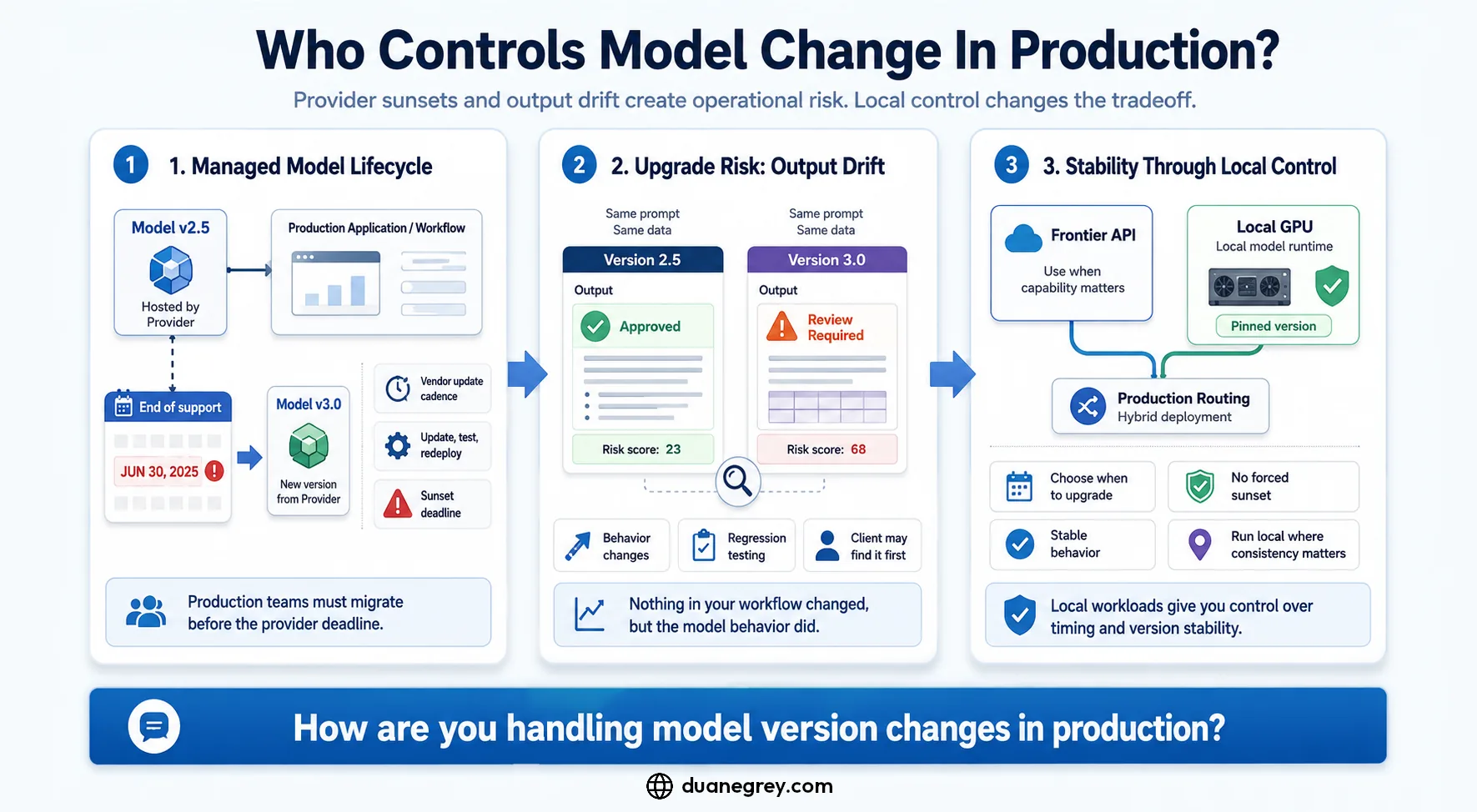
When Gemini 2.5 reaches end of life, there's no automatic migration to 3.0. Production workflows need updating, testing, and redeploying before the sunset deadline. I'm on my provider's update cadence, not mine.
Then there's output drift. Same prompt, same data, different results after an upgrade. That means regression testing on a system where the behavior changes without you changing anything. How many teams will find out something shifted when a client flags it.
Running non-frontier workloads on local GPU started as a cost decision. But it also solves this. You control when the model changes and whether it changes. No sunset deadlines, no surprise output drift. Use the frontier API where you need it, run local where stability matters more than capability.
Research
Models inferred unspecified requirements correctly 41.1 percent of the time by default, and underspecified prompts were twice as likely to regress when the model or prompt changed, with accuracy drops sometimes exceeding 20 points.
What Prompts Don't Say: Understanding and Managing Underspecification in LLM Prompts, arXiv:2505.13360, 2025
How are you handling model version changes in production?

Written by Duane Grey
AI Strategy & Implementation
Independent AI consultant helping companies cut through hype and deploy systems that produce real results.