Find this useful? Share the visual.
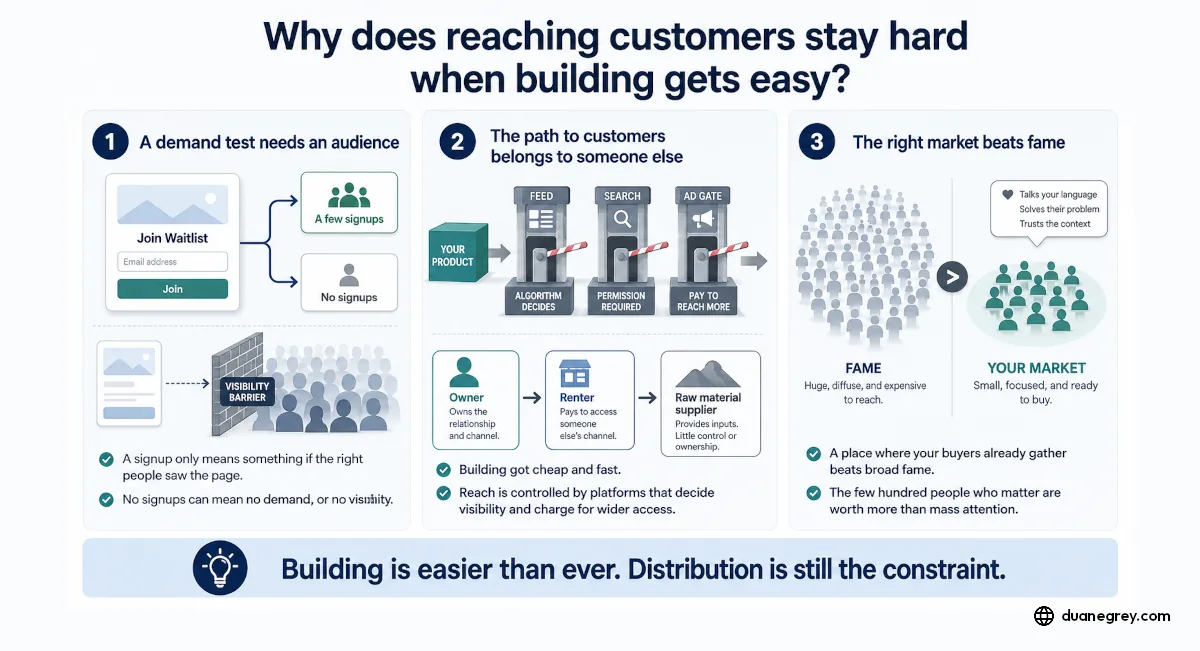
The Short Version
A demand test means little unless the right people see it, and whether they see it stopped being the founder's call. The path to buyers has been handed to intermediaries one piece at a time, from owned lists, to rented platform reach, and now AI answers assembled from your work. What did not get cheaper when building got easier is owning the path to your customers.
Reaching customers stays hard because the path to them belongs to someone else. A demand test, the landing page or the waiting list, means little unless the right people see it. Building the product got cheap and fast. The channels you use to reach customers are controlled by the platforms, which decide whether your product is seen and charge you to get in front of a wider audience.
A Demand Test Needs an Audience to Mean Anything
Put up a landing page with a signup. People sign up, or they do not. No signups has two readings. Maybe the thing has no buyers. Or maybe the buyers who exist did not see the page. Without a way to reach the people who might buy, those two look identical.
The numbers a test does produce are polluted on top of that. Third party audits now estimate that automated traffic, including crawlers and AI agents, is over half of everything moving on the web. Bot visits drag down the conversion rate on a page real people would have liked. A page with no traffic tells you about your intermediary's willingness to show you, not about your idea. The demand question stays open, and you have spent the effort feeling like you closed it.
From Owner, to Renter, to Raw Material Supplier
For a stretch of the web, a builder owned the path. Someone who subscribed to your site or joined your email list saw your next thing. Delivery was the deal, and the deal did not change under you.
Social platforms replaced that with rented reach, and the rent keeps rising. Instagram showed a business account's posts to 10 to 15 percent of its followers in 2020; third party audits now measure 2 to 3.5 percent, and under 1 percent for larger accounts. A LinkedIn company page post is shown to a sliver of the people who chose to follow it, and even personal reach, the healthiest organic channel left, dropped by about a third in a single year. Following someone stopped meaning you would see their work. The platform decides, based on its own profits and the current algorithm.
AI answer engines are the third step. When one answers a query directly, most of those searches end without a click to any site. The engine reads your work, responds with it, and keeps the visitor. The people who do click through convert unusually well, the audits say, but they are a fraction of what search once sent. Your work stopped being the destination and became the material the response is built from.
Cheap Content Raised the Bar for Earning an Audience
The tools that made the product cheap to build made audience content cheap to produce, and the cheapness became detectable. One analysis of twenty thousand search terms found human written pages ranked first roughly eight times as often as raw AI text. In surveys, most readers say they disengage from content they suspect was generated. Most top ranked results do contain some AI in the workflow. The penalty comes when the tools drive the output until it stops reading like a person wrote it.
That raises the bar rather than lowering it. Generating more content faster produced a backlash against AI writing, so what earns a stranger's attention now is the human part no tool can copy. Why you made the call you did, or the error that aged you a year before you found the cause.
Your Own Audience Skews the Test
Build a following that trusts you and it will try whatever you ship, at least once. Put up a waiting list for something the market does not need and a few thousand of them still sign up, because it came from you. The list measures how much they trust you and gets mistaken for a validated idea.
Reach gets people to the page. Trust gets them to sign up. Neither one is about whether the product is good.
A Place in the Right Market Beats Fame
You need a place in the market your buyers already occupy. It can be a forum they gather in, or the client list from a past job. Being in that room with the few hundred people who matter to your idea beats broad fame.
Building a brand from nothing takes years. Borrowing from a market you are already a part of can be fast, because the audience is there and they know who you are. Time already spent in a market gets your idea in front of the right people in a way a louder outsider cannot buy.
A competitor cannot copy it, either. They can rebuild your product, but the years you spent earning your spot in that market do not transfer. The companion piece here, on what an MVP must prove when AI makes building cheap, covers the rest of what survives a copy.
Why the Advice Stays Generic
Most advice skips distribution because it cannot be solved the same way for everyone. Your channel depends on your market and on where you already have standing. A writer can hand you the landing page playbook because it is the same playbook no matter who picks it up. No writer can hand you an audience, because yours would be specific to you.
The advice that gets repeated is real. It says build a newsletter, or stand up a community, or gather five hundred subscribers who have the problem. Those are seasons of work, sometimes years, presented as a checklist step. It sells what generalizes and leaves out what is specific to you. You are left to find where it applies by living it, usually after the product is built and waiting for traffic that does not come.
Questions Before You Trust a Demand Test
Before you read anything into a landing page or a waiting list, these are worth answering.
- How did people get to this page? If you cannot describe the channel, the result is about your traffic, not your idea.
- How much of that traffic was human? When bots are more than half the web, a raw visit count is not evidence.
- Do the visitors know you already? If they came because they trust you, their signups measure your reputation more than the product.
- Where do the people with this problem already gather, and do you have standing there? That access is the test behind the test.
- If the honest answer is that you have no reach yet, is your real first project the product, or the audience?
What Did Not Get Cheaper
AI made the product cheap to build and left the path to customers in other hands. The web platforms have taken over the path to the customer one piece at a time, each in exchange for a promise. The platforms promised reach in return for content. The answer engines promise citations in return for material. You've been moved from owner, to renter, to raw material supplier, and told to trust that it pays off later.
The channels worth the most now are the ones no platform can reprice, the list you own and the standing you have earned in the places your buyers already are. For most first time builders, that is the real first project, and it is the one part of the work the tools have not compressed.
Before you trust that silence after a launch means no demand, can you name how anyone was supposed to find it?
By the Numbers
Automated traffic accounted for more than 53% of all web traffic in 2025, up from 51% the year before, with bad bots alone at 40%. Human activity fell to 47% and continues to fall, so a raw visit count on a landing page is no longer evidence that people saw it.
Imperva/Thales, Bad Bot Report 2026
In the first four months of 2026, 68% of Google searches ended without a click to any site, up from 60% in 2024. The engine answers from the material and keeps the visitor.
SparkToro, 'In 2026, Less than One Third of Google Searches Still Send a Click,' 2026
Across an analysis of 20,000 keywords and their top ten results, human-written pages were roughly eight times more likely than purely AI-generated pages to hold the number one position. The gap was widest at position one and held across the whole top ten.
Semrush analysis of 20,000 keywords, 2026 (reported by Search Engine Land)

Written by Duane Grey
AI Strategy & Implementation
Independent AI consultant helping companies cut through hype and deploy systems that produce real results.