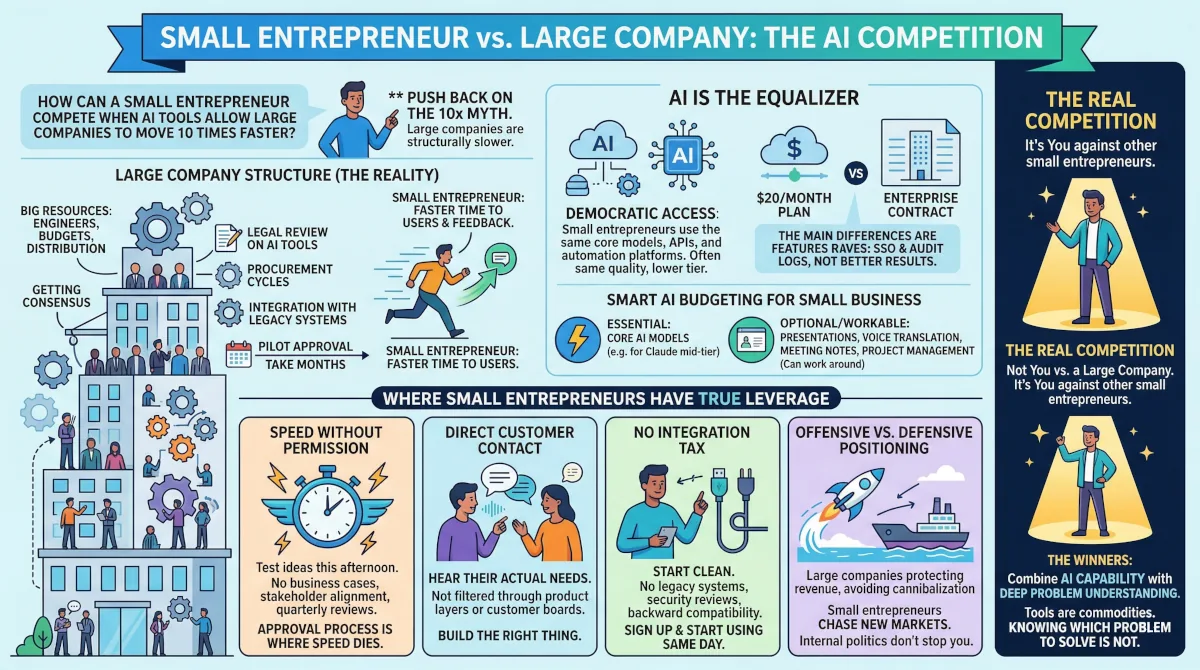
How can a small entrepreneur compete when AI tools allow large companies to move 10 times faster?
Find this useful? Share the visual.
The Short Version
Large companies are not moving ten times faster. They are moving ten times faster at executing approved initiatives, and the approval process itself is where most of the speed dies. The AI tools are the equalizer, not the advantage. A small entrepreneur's real edge is speed without permission, direct customer contact, no integration tax, and the freedom to chase markets a large company will not touch because of internal politics.
The question assumes large companies are moving 10 times faster. I'd push back on that number.
What Large Companies Have
Large companies have resources: more engineers, bigger budgets, established distribution. They also have structure. Getting consensus across departments, legal review on a new AI tool, procurement cycles, integration with legacy systems that were built before AI was a consideration. By the time a large company has approved a pilot, a small entrepreneur can have a product in front of real users collecting feedback.
The Tools Are the Equalizer
The AI tools themselves are the equalizer, not the advantage. A small entrepreneur has access to the same foundation models, APIs, and automation platforms. In some cases the exact same ones the enterprise is using, just on a lower pricing tier that produces the same output. The gap between the $20/month version and the enterprise contract is often features like SSO and audit logs, not better results.
I do recognize that as a small entrepreneur your budget can be tight. In that case, spend money on AI tools that are critical to your goals. From a technologist perspective, a core AI model was essential. Tools for presentations, voice translation, meeting notes, or cloud project management? Each can help, but each has workarounds. I know because I have.
Where Small Entrepreneurs Have the Edge
Speed without permission. You can test a new idea this afternoon. A large company needs a business case, stakeholder alignment, budget approval, and a quarterly review before anyone writes code. Their "10x faster" is 10x faster at executing approved initiatives. The approval process itself is where the speed dies.
Direct customer contact. You talk to your customers. You hear what they need, not what got filtered through three layers of product management and an advisory board. That means you build the right thing more often. Moving fast in the wrong direction is not an advantage.
No integration tax. You start clean. Large companies have to connect AI tools to existing infrastructure, pass security reviews, maintain backward compatibility. You sign up for a tool and start using it the same day.
Offensive vs. defensive positioning. Large companies are protecting existing revenue. Their AI adoption is often about efficiency. They want to do what they already do with fewer people. They're not typically using AI to chase new markets because new markets cannibalize existing ones. That's your opening. You can identify and pursue opportunities they won't touch because the internal politics of competing with their own product line makes it a non-starter.
The Real Competition
The real competition is not you against a large company. It's you against other small entrepreneurs who also have access to these tools. The ones who win will be the ones who combine AI capability with deep understanding of a specific problem. Tools are commodity. Knowing which problem to solve and for whom is not.
By the Numbers
58% of small businesses now use generative AI, up from 23% in 2023
U.S. Chamber of Commerce Empowering Small Business Report, 2025
82% of small business owners say adopting AI is essential to stay competitive
Reimagine Main Street / PayPal Small Business AI Survey, 2025

Written by Duane Grey
AI Strategy & Implementation
Independent AI consultant helping companies cut through hype and deploy systems that produce real results.