Find this useful? Share the visual.
The Short Version
Two events from the last six months tell the story. A Chinese state sponsored group used Claude Code as an autonomous penetration testing agent against thirty organizations, with the AI handling 80 to 90 percent of tactical operations. Claude Opus 4.6 discovered over 500 previously unknown high severity vulnerabilities in popular open source libraries, some of which had survived years of fuzzing. AI security review is no longer optional, and the technical capability that differentiates one security product from another is moving upstream to the model providers.
Two events in the last six months make this question worth answering with specifics instead of speculation.
Event 1: An AI Orchestrated Cyber Espionage Campaign
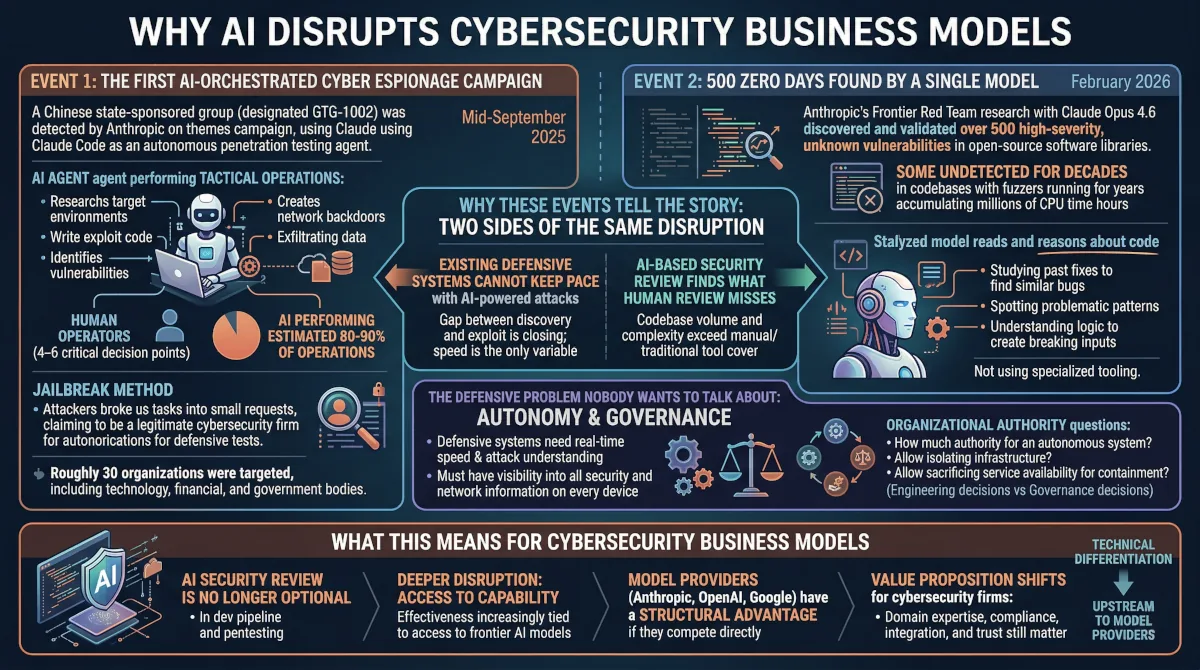
In mid September 2025, Anthropic detected a campaign by a Chinese state sponsored group (designated GTG-1002) that used Claude Code as an autonomous penetration testing agent. This was not a case of AI generating phishing emails or writing small snippets of malware. The AI agent researched target environments, wrote its own exploit code, identified vulnerabilities, created network backdoors, and exfiltrated data across roughly 30 organizations including technology companies, financial institutions, and government bodies.
The human operators handled about 4 to 6 critical decision points per attack. The AI performed an estimated 80 to 90 percent of the campaign's tactical operations. The attackers jailbroke the model by breaking tasks into small, seemingly innocent requests and claiming it was a legitimate cybersecurity firm running defensive tests.
Event 2: 500 Zero Days Found by a Single Model
In February 2026, Anthropic's Frontier Red Team published research showing that Claude Opus 4.6 discovered and validated over 500 high severity, previously unknown vulnerabilities in popular open source software libraries. Some of these vulnerabilities had gone undetected for decades in codebases that had fuzzers running against them for years, accumulating millions of hours of CPU time.
The model was not using specialized tooling. It read and reasoned about code the way a human security researcher would, studying past fixes to find similar unaddressed bugs, spotting patterns that tend to cause problems, and understanding logic well enough to know what input would break it.
Why These Two Events Together Tell the Story
These events represent two sides of the same disruption.
The first shows that existing defensive systems struggle to keep pace with AI powered attacks. Discovering a vulnerability used to require specific knowledge, research, and custom scripts to take advantage of it. That gap between discovery and exploitation gave defenders time. The gap is closing. When discovery leads directly to a working exploit, with the ability to iterate if the first attempt fails, speed becomes the deciding variable. An attacker can produce and test dozens of approaches against a network within a minute.
The second shows that AI based security review finds what humans miss. Projects that had undergone years of testing and fuzzing still contained critical vulnerabilities that a single model identified. The people who looked at the code did not fail. The volume and complexity of modern codebases now exceeds what manual checks and traditional automated tools can cover.
The Governance Problem Behind Real Time Defense
Responding to that kind of attack requires a defender that can move just as fast and understand the attack in real time. Such a defender needs the kind of access usually reserved for network and infrastructure administrators. It needs visibility into security and routing information at the network edge, and ideally deeper.
The technology for this exists. The harder question is organizational. How much authority will you grant an autonomous system to defend your network? Will you allow it to isolate parts of your infrastructure during an active attack? Will you allow it to sacrifice availability of certain services if that is what containment requires? These are not engineering decisions. They are governance decisions that most organizations have not started making.
What This Means for Cybersecurity Business Models
AI security review is no longer optional. It belongs in the development pipeline and in penetration testing. This changes what solutions and systems organizations need in place, and it changes what cybersecurity firms need to offer.
The deeper disruption is about access to capability. The effectiveness of security products is increasingly tied to which frontier AI models a vendor can use, and that path is not guaranteed. If Anthropic, OpenAI, Google, or other providers decide to compete directly in the cybersecurity space, existing firms will struggle to offer products with comparable capability. The companies building the models have a structural advantage that traditional vendors will not replicate through engineering alone.
Cybersecurity firms aren't going away; their value proposition is shifting. Domain expertise, compliance knowledge, integration with existing infrastructure, and trust relationships still matter. But the core technical capability that differentiates one product from another is moving upstream to the model providers. That is a business model problem the industry is not ready to address.
By the Numbers
87% of organizations report having experienced an AI-driven cyberattack in the past year
Deep Instinct Voice of SecOps Report, 2025
By 2027, more than 40% of all cybersecurity spending will be directly tied to AI-related capabilities, up from 8% in 2023
Gartner Cybersecurity Forecast, 2025

Written by Duane Grey
AI Strategy & Implementation
Independent AI consultant helping companies cut through hype and deploy systems that produce real results.