Does a business owner need to write down their manual steps on paper before they start building an automated workflow?
Find this useful? Share the visual.
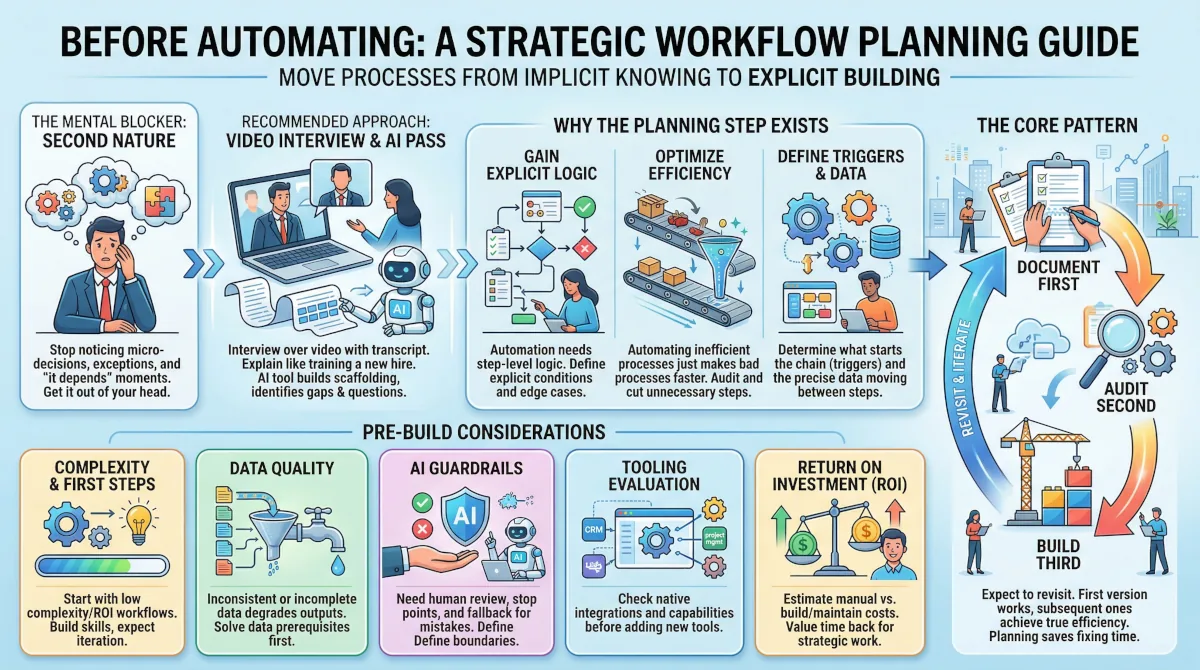
The Short Version
You do not need to write it down on paper, but you do need to get it out of your head. Most business owners know their process so well they stop noticing the micro decisions and exceptions that happen between steps. The fix is an interview with the transcript running, then an AI pass that builds out the scaffolding and flags follow up questions. Document first, audit second, build third. Skipping the first two costs more time than it saves.
You don't need to write it down on paper specifically. But you do need to get it out of your head, and most people underestimate how hard that is.
The Mental Blocker Is Real
Most business owners know their process so well they've stopped noticing it. When something becomes second nature, you stop seeing the micro decisions, the exceptions, the "it depends" moments that happen between steps. You can't hand that to a system and expect it to figure out what you skipped.
Have someone interview you about the process over a video call with the transcript running. Walk through it like you're training a new hire. Then pass that transcript through an AI tool to build out the scaffolding of what needs to happen, with analysis on possible gaps and follow up questions. The interview format forces you to explain things you normally wouldn't articulate, and the AI pass catches the holes you talked around without realizing it.
Why the Planning Step Exists
Three reasons most people learn the hard way.
First, you can't automate what you don't understand at a step level. Building an automation requires explicit logic. If the manual process lives in your head, you will miss conditions and edge cases once you start building. The system won't guess what you meant.
Second, automating an inefficient process just makes a bad process run faster. Mapping it out forces you to audit the workflow and cut unnecessary steps before you encode them into something that runs on its own.
Third, if your workflow relies on external triggers, documenting the process helps you define what starts the chain and what data needs to move between each step. Triggers that seem obvious when you do them manually become ambiguous when a system needs to detect them.
What Else to Think Through Before You Build
Complexity and First Steps
If you can identify a low complexity workflow with some return on investment, start there. You get familiar with the tooling, you build foundational skills, and you learn how your systems connect. Your first automation will not be your best, and that's fine. Iteration is where the real value shows up.
Data Quality
Your automation depends on the data feeding it. If those inputs are inconsistent, incomplete, or drifting over time, the outputs will degrade. If you don't have what you need yet, that's a prerequisite to solve before you automate around it.
AI Guardrails
If any part of the workflow involves AI making decisions or generating output, you need guardrails. What happens when the model produces something wrong? Who reviews it? What's the fallback? An AI step without boundaries is a liability, not an efficiency gain.
Tooling Evaluation
Before building, evaluate what your current tools can already do. Check for native integrations and automation capabilities you might not be using. Determine whether you need additional tooling or if what you have can handle the workflow with some configuration.
Return on Investment
Estimate the cost of doing the process manually, then compare it against the cost of building and maintaining the automation. Don't limit this to direct dollar savings. Time you get back to spend on strategic work has real value, even if it doesn't show up on a line item.
The Sequence
Document first, audit second, build third. The people who jump straight to building spend more time fixing than they saved by skipping the planning. And expect to revisit what you built. The first version gets the job done. The second and third versions are where you start seeing the kind of specialization and efficiency that makes the investment worth it.
By the Numbers
70% of automation resources are typically consumed by pre-automation processes including documentation, mapping, and planning
IBM, Why You Need Process Mining in Your RPA Strategy, 2022
Automating workflows can reduce errors by 70%, but only when the underlying process is well defined before implementation
Gitnux, Business Process Automation Report, 2024

Written by Duane Grey
AI Strategy & Implementation
Independent AI consultant helping companies cut through hype and deploy systems that produce real results.