Find this useful? Share the visual.
The Short Version
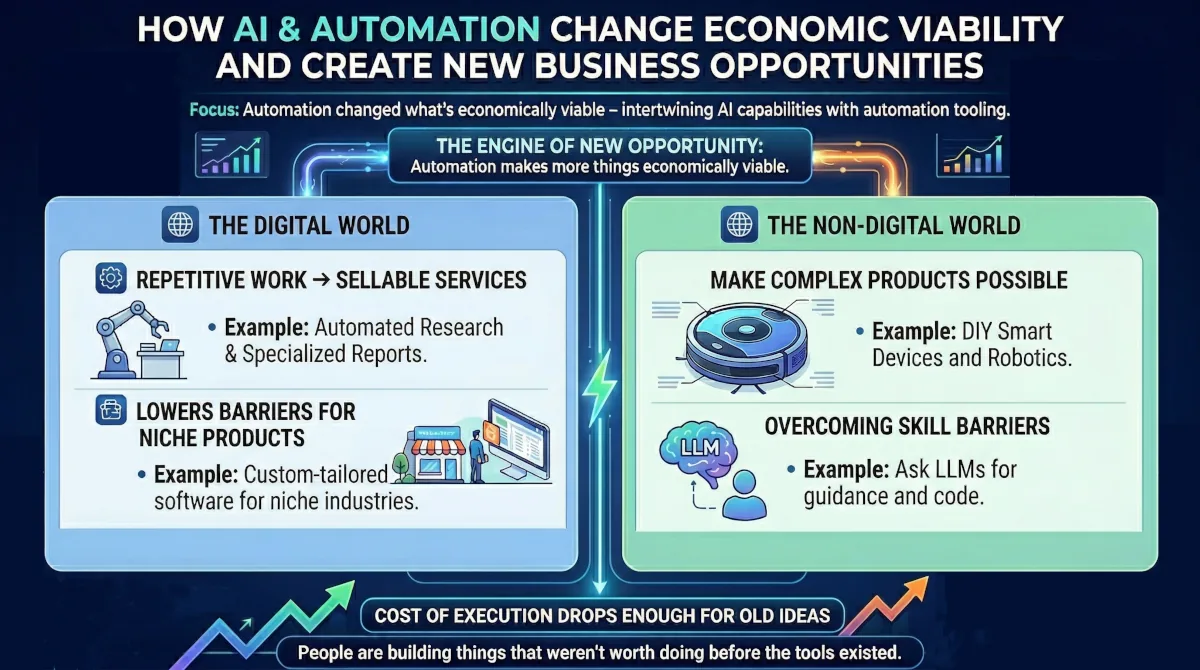
Automation has changed what is economically viable. That is the real engine behind new business opportunities. Entire categories of products and services are emerging not because someone had a new idea, but because the cost of execution dropped enough to make an old idea pencil out. A single person with the right tooling can deliver what used to require a consulting team, or build a niche product for a market that was too small to justify before.
If you dig underneath most of the advice about AI and automation, the same idea keeps surfacing. Automation has changed what's economically viable. That's the real engine behind new business opportunities.
The Digital World
Automation creates opportunities because it turns repetitive manual work into a sellable service. You can build a business around enabling others to use current automation technologies for research that augments their decision capabilities. Competitor research, market opportunities, revenue areas that can be expanded. A single person with the right tooling can deliver what used to require a consulting team, and charge a fraction of what they would cost.
Automation also lowers the barrier to create niche products for specific industries. Think about compliance reporting for daycare facilities, or report generation for property managers: maintenance logs, inspection summaries, tenant communications. These are real problems that specific businesses pay to solve, but the market was too small to justify building custom software for. When automation drops the cost of building and maintaining these tools, suddenly a niche product with 50 customers is a viable business.
The Physical World
The same principle applies outside of digital products. I wanted to test this idea, so I picked something outside my range. Making a product to compete in the automated vacuum segment.
I asked Claude Code if it could provide code for an Arduino chip to create my own version. The response included motor control, obstacle detection, navigation logic, and optional extras like bump switches and cliff sensors. It wanted to recommend a full parts list before I stopped it.
This stretches the term automation because to make it look decent I would probably need a 3D printer for the shell. But the point stands. If I need help learning soldering, circuit board creation, or 3D modeling, I can just ask. It may look terrible and not work the first time, but how long until I have a working product?
What's Driving the Shift
From what I've seen, entire categories of products and services are emerging not because someone had a new idea, but because the cost of execution dropped enough to make an old idea finally pencil out. People are building things that weren't worth doing before the tools existed.
By the Numbers
By 2025, 70% of new applications use low-code or no-code technologies, up from less than 25% in 2020
Gartner, 2021 (validated by 2025 market data)
Automation will displace 92 million jobs but create 170 million new roles by 2030, a net gain of 78 million jobs
World Economic Forum Future of Jobs Report, 2025

Written by Duane Grey
AI Strategy & Implementation
Independent AI consultant helping companies cut through hype and deploy systems that produce real results.