The Great Reboot: AI The New Operating System
Throughout my career, there have been pivotal moments where I have had to refresh my skills or dive into entirely new domains. I would refer to these periods as reboots. These were not casual updates; they were full-scale learning reboots with hands-on projects. The last two stand out clearly: one came after a deep focus on enterprise architecture and infrastructure design, when I needed to retool my Java skills (specifically Spring Boot) and immerse myself in containerization with Docker and Kubernetes. The other was a shift into cloud infrastructure and Infrastructure as Code, which fundamentally changed how I thought about deployment and scalability.
Now, I'm in the midst of what I call The Great Reboot. This time, it is not just personal, it is collective. Everyone in IT is facing it. We are not just adapting to a new toolset or a faster framework. We are confronting a new paradigm. AI is not a better version of what came before, it is a new operating system for how we build, interact, and innovate.
Technology is accelerating. Discovery cycles are compressing. Systems are becoming intelligent collaborators. And as an industry, we are redefining our interfaces from keyboards to voice, from static dashboards to dynamic assistants. The idea that everyone will have or should be building their own AI agent is quickly becoming reality.
So, let us unpack what this reboot means for the future of work, learning, and leadership. We all need to prepare ourselves to thrive in this new operating system.
From Acceleration to Replication: Why AI Is Different
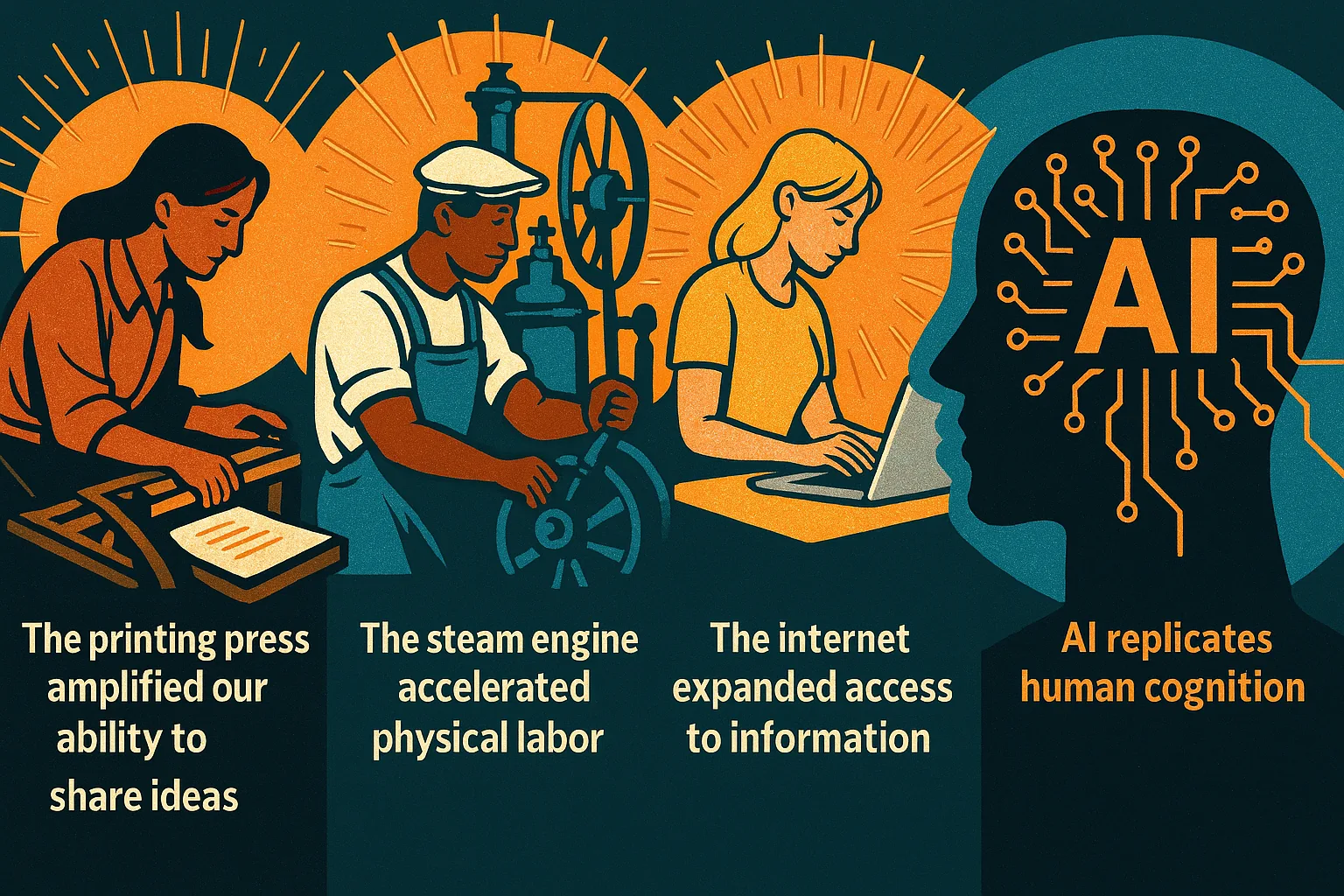
Historically, technology has served as a force multiplier for human intelligence, not a substitute for it. The printing press amplified our ability to share ideas. The steam engine accelerated physical labor. The internet expanded access to information. But in each case, humans remained at the center of thinking, deciding, creating.
AI changes that.
For the first time, we are not just accelerating human cognition—we are replicating it. Large language models can reason, summarize, translate, and even strategize. They do not just execute, they emulate. And that shift from augmentation to replication marks a profound turning point.
So, when I hear people say,"Every major technological leap has eliminated jobs while creating new industries," we must also acknowledge: AI does this faster, at greater scale, and with deeper cognitive reach than anything before.
- The printing press created new jobs in bookbinding, typography, and copyediting. AI creates new jobs in data science, machine learning, and AI ethics. The printing press disrupted scribes. AI disrupts analysts, writers, coders, and consultants.
- The internet created new jobs in e-commerce and digital media. AI creates new jobs in model tuning, agent design, and synthetic media, but it also compresses entire departments into a group of people with AI tools.
This is not just a faster cycle; it is a more comprehensive one. The difference now is not just speed and scale. It is depth. AI is currently challenging our understanding of what we once thought was uniquely human.
The New IT Role: From Maintainer to AI Steward
IT has been keeping systems running, patching servers, provisioning hardware, and ensuring up-time for platforms that help meet a business need. In the AI-powered enterprise the role of IT will also include delivering interfaces or integration points that bring intelligence to every touchpoint with the desire that every system not only responds, but understands, anticipates, and evolves.
Meet the AI Steward.
I was chatting with a friend recently about the difference between coding in VS Code versus Cursor. At one point, he said something that stuck with me: "I'm not writing code anymore, I'm managing how the code gets written." That shift, subtle but profound, frees him to focus on the architecture, the design, the creative intent, rather than the plumbing that makes it all run.And that is the essence of what is changing.
We are not just becoming coders, builders, or operators. We are becoming stewards, bringing online intelligent systems to shape outcomes. The role is evolving from execution to oversight, from manual to strategic. In the age of AI, we are all stepping into a new kind of leadership. It is about curating models, governing data flows, and ensuring ethical, secure, and effective deployment of AI across the organization. AI stewards are translators between business needs and model capabilities. They are responsible for:
- Selecting and fine-tuning foundation models for specific use cases
- Managing data pipelines and retrieval-augmented generation (RAG) systems
- Monitoring AI behavior for bias, drift, and hallucination
- Establishing governance frameworks for responsible AI use
Hands-On Learning vs Surface-Level Understanding of AI
There is a substantial difference between knowing what AI is and knowing how to integrate it into something that makes your organization more effective. I have never been a fan of just reading books or headlines, watching demos (Yes, I have watched countless YouTube videos about AI and agents). I believe if you really want to know something you must go hands-on. I am not sure if that is because the start of my career was development or if it is just the way I learned the best.
True understanding comes from direct experimentation, building prompts, chaining tools, fine-tuning workflows, and seeing where things break. Everyone needs to watch your coding agent go into a never-ending loop trying to fix code as it keeps breaking and you think to yourself, "I wonder how much I just spent in tokens the last 15 minutes". It helps remind you of the current boundaries of these models and how best to interact with them.
As organization you can start training people on "what AI is" but it is best for someone to have firsthand experience to understand "how to wield it." Be careful of slowing adoption because you are managing token usage as line item on IT spend. You cannot allow spending to go unchecked but consult with your people on right-sizing these limitations. To bridge this gap, leaders must create safe spaces for experimentation:
- Hack days where teams can prototype AI-powered solutions
- Internal sandboxes for testing agents, APIs, and RAG pipelines
- Cross-functional groups that share what they have learned across departments
The goal is not to make everyone a machine learning engineer. It is to make AI feel less like magic and more like muscle memory.
Mindset Shift in Task Automation: The "Automation-First" Philosophy
In my career, automation tended to be reactive and targeted at what was painful, repetitive, or expensive. Also, processes tended to be born from painful failures or accidents that management demanded never happen again. In this era, we need to flip from reactive to proactive automation. We will analyze processes to determine if automation is needed and what slows down adoption and transformation.
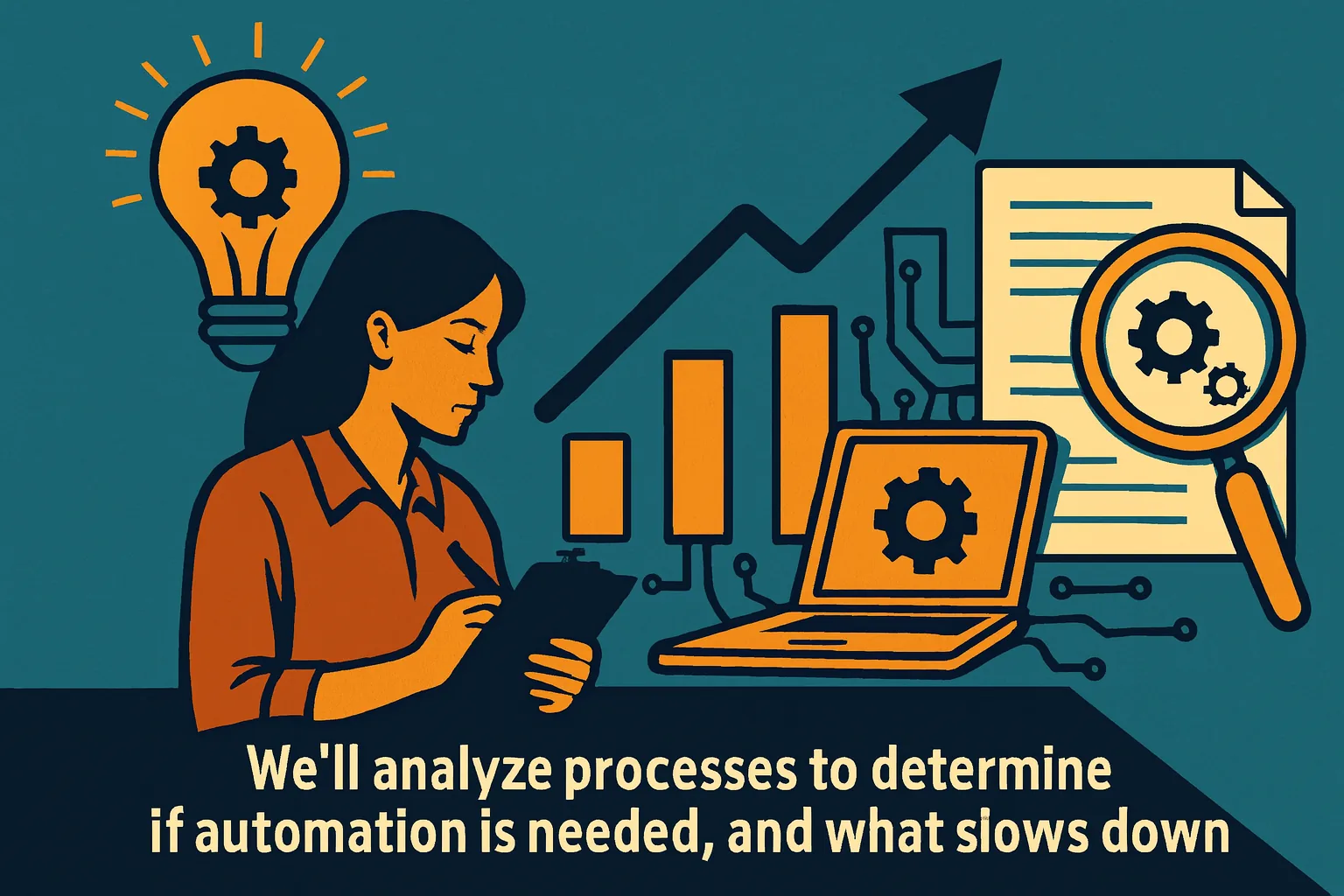
The philosophy of "automation-first" means we assume every task can be automated until proven otherwise. It is a proactive posture that asks:
- "Why is this still manual?"
- "What's the smallest unit of work we can delegate to AI?"
- "How can we design this process to be machine-accelerated from day one?"
This shift unlocks exponential gains. Consider:
- A recruiter who uses AI to screen resumes, draft outreach, and prep interviews
- A marketer who automates A/B testing, content generation, and campaign analysis
- A developer who uses AI to write boilerplate code, generate tests, and debug errors
In each case, the human shifts from execution to orchestration. It is less about doing the task and more about shaping how the task gets done.
Continuous Evolution: Why RAG and New Tools Demand Lifelong Learning
The AI landscape is evolving at breakneck speed. What was innovative six months ago is now table stakes. Take Retrieval-Augmented Generation (RAG), for example. It is not just a buzzword—it's a foundational architecture that fuses the reasoning capabilities of large language models with the precision of curated, task-specific data. This is how enterprises are grounding AI in real-world context and domain expertise.
But even RAG is evolving. Tools like Claude's Skills now allow models to dynamically load relevant data on demand, streamlining context injection without manual prompt engineering. Meanwhile, Google's File Search Tool, part of the Gemini API, simplifies how developers implement RAG-like behavior by enabling seamless access to structured and unstructured data. These innovations do not just improve RAG—they compress its complexity, making it more accessible, more modular, and more powerful.
But RAG is just one example. We are also seeing:
- Vector databases for semantic search
- Agentic frameworks for multi-step reasoning
- Fine-tuning for domain-specific adaptation
- Open-source models that rival closed ones in performance
To keep up, professionals must adopt a mindset of lifelong learning. This means:
- Subscribing to AI research digests and newsletters
- Participating in community forums and open-source projects
- Allocating time each week to explore new tools and techniques
In the Great Reboot, the most valuable skill is not what you know, it is how fast you can learn. In IT, you will constantly face unfamiliar tasks and novel problems. The pace of change guarantees it. Static expertise will not cut it anymore. What matters is your ability to adapt, explore, and evolve. Lifelong learning is not a nice-to-have, it is the baseline for staying relevant in a world where yesterday's edge is today's expectation. The good news is the same AI models that challenge us can also teach us.
The AI-Powered Classroom is Everywhere: Tutors at Scale
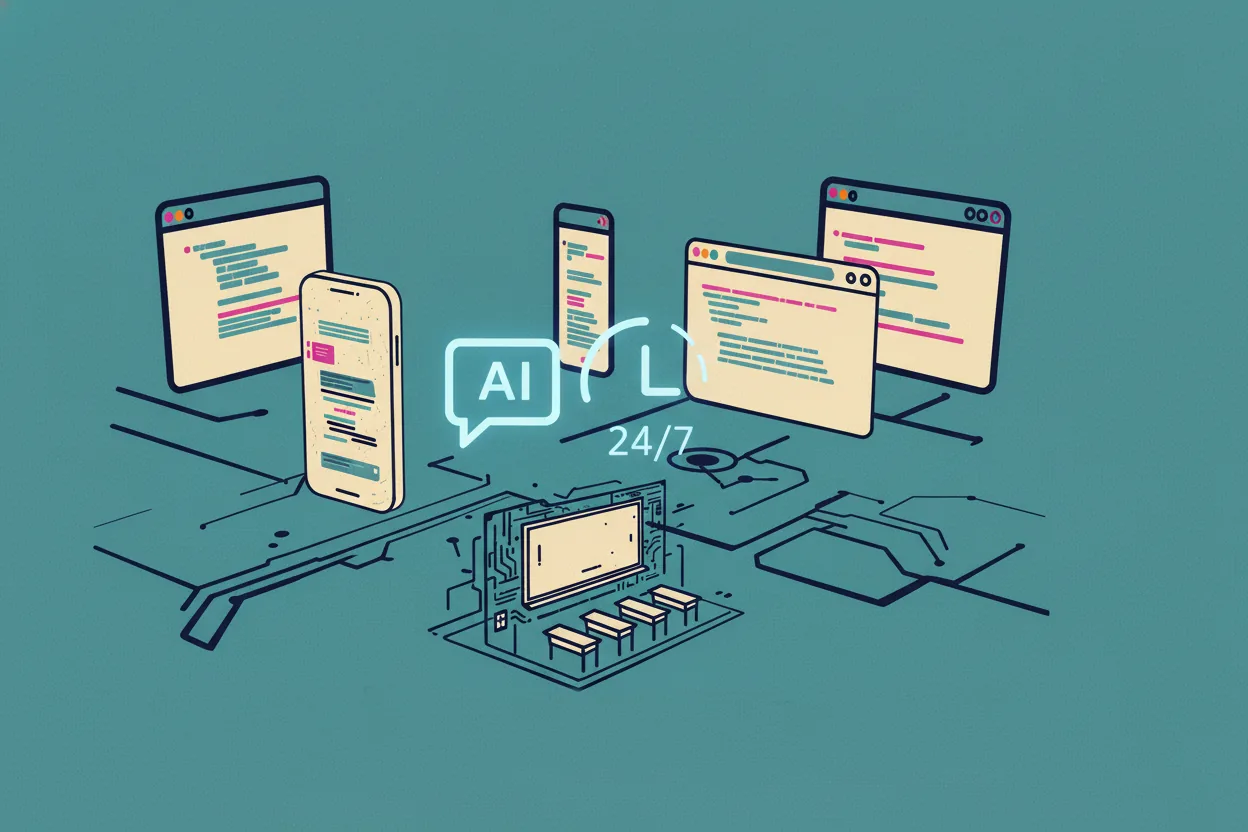
Education is undergoing its own reboot and this time; it is not confined to lecture halls or LMS platforms. The classroom now lives in your browser, your phone, your IDE. If you have access to a chat interface, you have access to a tutor—one that's available 24/7, never judges, and can walk you through anything from debugging code to refining strategy.
I am challenging myself—and others—to move beyond passive consumption and into active creation. Yes, it can feel overwhelming, like drinking from a firehose. But that is the nature of exponential learning. The good news? You are never alone in it. AI is transforming education from a one-size-fits-all model into a personalized, always-on learning environment. And that shift carries profound implications:
This has profound implications:
- Anyone can be a student getting instant feedback on writing, coding, ideation, and strategic thinking.
- Teachers can offload administrative tasks and focus on mentorship, guidance, and deeper engagement.
- Lifelong learners can explore new domains without gatekeepers or institutional barriers.
But it also demands discipline:
- We must resist the temptation to outsource thinking in an era of instant answers.
- We must learn even as the "how" is generated for us by staying curious, critical, and intentional.
Welcome to the new way to learn.
AI Literacy Meets Cybersecurity: The New Critical Skillset
As AI becomes more embedded in our workflows, it also becomes a new attack surface: prompt injection, model inversion, and data leakage. New platforms mean bad actors will introduce new threats. Understanding these new attack surfaces will require a new kind of literacy—one that benefits from both AI fluency and cybersecurity awareness.
Every employee who interacts with AI—whether through a chatbot, a code assistant, or a custom agent—needs to understand:
- How prompts can be manipulated
- What data is being exposed to third-party models
- How to validate AI-generated outputs
- When to escalate suspicious behavior
This is not just the CISO's problem. It is everyone's responsibility. And it starts with education, simulation, and clear policies. In the same way we train employees to spot phishing emails, we must now train them to spot AI hallucinations, jailbreaks, and data leaks.
Beyond the Hype: Embracing the Great Reboot
AI is not a trend. It is a tectonic shift.
The Great Reboot is already underway. It changes how we work, how we learn, and how we lead. And while the pace of change can feel overwhelming, the opportunity is profound.
So where do you start?
- Pick one task this week and ask: "Can this be automated?"
- Try a new tool and see how it can change your workflow or how you manage your daily tasks
- Start a conversation about AI literacy, tools, or experimentation with someone you know
The future is not waiting. And neither should you.
Welcome to the new operating system.
Want to Discuss This?
Let's connect and explore how AI can work for your business.
Start a Conversation